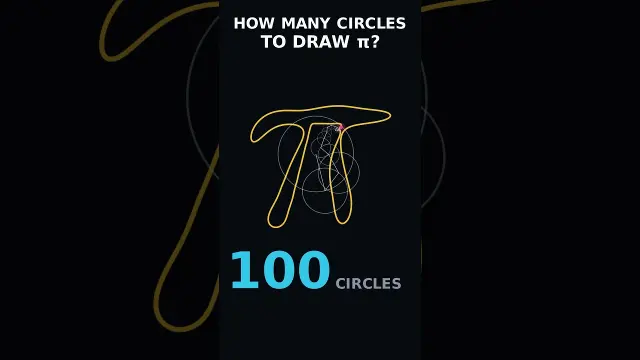
 Drawing the Pi Symbol Using Rotating Fourier Series Circles
#Fourier Series
1 ideas
Drawing the Pi Symbol Using Rotating Fourier Series Circles
Get new #Fourier Series ideas by email
Every Thursday: the week's best ideas, with the newest from #Fourier Series.
Related tags
Fourier Series: Turning Waves into Sines and Cosines
Fourier series are a way of writing a repeating pattern as a sum of simple waves. Instead of looking at a complicated periodic shape all at once, you break it into sine and cosine terms of different frequencies. This gives you a new view of the same function: not as a single curve, but as a combination of harmonics.
The idea comes from the work of Joseph Fourier, who studied how heat and vibration can be described with wave-like building blocks. Since then, Fourier series have become a basic tool in mathematics, physics, engineering, and signal analysis. Whenever something repeats over time or space, a Fourier series may help describe it.
What a Fourier series does
A periodic function repeats after a fixed interval. A Fourier series expresses that function as:
Read more
- a constant term, which sets the overall level
- sine and cosine terms, which add oscillations of different frequencies
The low-frequency terms describe the broad shape, while the higher-frequency terms add finer details. If you include more terms, the approximation usually becomes more accurate.
This is why Fourier series are so useful. They let you study a complicated pattern piece by piece. You can see which frequencies matter most, how smooth or sharp a signal is, and how different wave components combine.
Where you see them
Fourier series appear in many places where repetition matters. They are used to model vibrations, sound, heat flow, electrical signals, and other cyclic behavior. They also help in understanding image and signal processing, where complex patterns can be analyzed in terms of frequency content.
In practical work, they are often used to simplify calculations, solve differential equations, and separate a signal into its parts. They are also a beautiful mathematical way to draw and reconstruct shapes made from rotating circles and waves.
Main forms and ideas
The most common version uses sines and cosines. In some settings, the same information is written with complex exponentials, which can make formulas shorter and easier to work with. Both forms describe the same underlying idea.
A few key concepts are worth knowing:
- Period: the length of one full repeat
- Frequency: how often a wave repeats
- Harmonics: integer multiples of the base frequency
- Coefficients: the numbers that tell you how much of each wave is present
Tips if you are learning it
Start with simple periodic shapes, like a square wave, triangle wave, or sawtooth wave. These examples show clearly how smooth waves can combine to make sharper edges and repeating patterns.
It also helps to remember that Fourier series are about approximation as much as exact representation. Some functions are smooth and easy to build from a few terms, while others need many terms. Near sharp jumps, the approximation can behave in surprising ways, so it is useful to look carefully at graphs and partial sums.
If you are new to the topic, focus first on the intuition: a complex repeatable pattern can be understood as a mixture of simpler waves. Once that idea makes sense, the formulas become much easier to follow.
Fourier series are one of the clearest examples of how a hard problem can become manageable when you view it in the right way.
Videos come from YouTube and posts from Instagram; titles and summaries are our own. All rights belong to their creators.