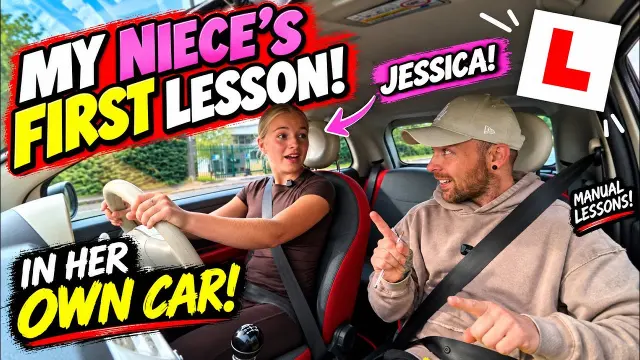
 Teaching a First Manual Lesson in a Pupil's Own Car
#Gear Changes
1 ideas
Teaching a First Manual Lesson in a Pupil's Own Car
Get new #Gear Changes ideas by email
Every Thursday: the week's best ideas, with the newest from #Gear Changes.
Related tags
Gear Changes: A Beginner's Guide to Manual Driving
A gear change is the moment a driver moves the transmission from one gear ratio to another, and in a manual car it is the driver, not a computer, who decides when and how it happens. The purpose is simple: engines produce useful power and torque only within a fairly narrow band of revolutions, so the gearbox sits between engine and wheels to translate that narrow band into the wide range of speeds a car actually needs. Low gears multiply torque for pulling away and climbing; high gears let the engine turn slowly at cruising speed, which is quieter and gentler on fuel.
What the clutch is doing
Between the engine and the gearbox sits the clutch, a friction coupling that can be opened and closed. Pressing the pedal separates the two, so the gears can be swapped without the engine's force fighting the change. Releasing it brings them back together. Almost all of the smoothness in manual driving comes from understanding this: the clutch is not an on-off switch but a gradual connection, and the middle part of its travel is where it begins to bite.
Changing up
Read more
To move to a higher gear, ease off the accelerator, press the clutch fully, move the lever through neutral into the next gear, then release the clutch and return to the throttle. The skill lies in matching the two: releasing the clutch too quickly makes the car lurch, releasing it too slowly while adding power wears the clutch plate. A common beginner's habit is to shift up too early in search of economy. If the engine feels laboured and the car strains to accelerate, the gear is too high.
Changing down
Downshifts need more care because the engine is being asked to spin faster than the road speed of the lower gear would naturally give. The usual remedy is to add a little throttle as the clutch comes back up, so engine speed roughly matches the new gear before the two are joined. This matching is what experienced drivers do without thinking, and it is worth practising deliberately. Downshifts are useful for braking with the engine on long descents, for having power ready before an overtake, and for keeping control on slippery surfaces.
Things beginners get wrong
- Riding the clutch: resting a foot on the pedal keeps it partly open and wears it needlessly.
- Holding the car on the clutch at a hill start instead of using the handbrake.
- Skipping gears downward at speed without matching engine speed.
- Looking at the lever while changing. Learn the gate by feel; your eyes belong on the road.
Getting smoother
Smoothness comes from timing rather than strength: a light, decisive hand on the lever, a steady left foot, and a pause of a fraction of a second in neutral. Practise on quiet roads and gentle gradients, and listen to the engine rather than watching the dial. With repetition the whole sequence becomes one movement, and gear changes stop being something you do and start being something the car does with you.
#Gear Changes: frequently asked questions
How do I get started learning to change gear in a manual car?
Start on a quiet, flat road where nothing forces you to hurry, and treat the clutch pedal as a gradual connection rather than a switch. Spend your first sessions simply finding the biting point and moving off and stopping, then add gear changes once that feels natural. Listening to the engine matters more than watching the rev counter, because the sound tells you when the car is happy in a gear.
Do I need any special equipment to practise gear changes?
No extra kit is required beyond the car itself; what you need is somewhere safe, unhurried and free of traffic while you build the movement into habit. It helps to have a patient, experienced driver beside you to point out when the engine is labouring or the clutch is being slipped too long. Once the basic sequence feels automatic, gentle slopes and busier roads can be added gradually.
How do I know when to change up and when to change down?
Change up when the engine has comfortably picked up speed and sounds willing rather than strained, and change down before it starts to lug or struggle to pull. Shifting up too eagerly in pursuit of economy is a common trap, because a gear that is too high leaves you with no response when you need to accelerate. The engine note is the most reliable guide, so learn what contented and laboured both sound like in your own car.
How should I look after the clutch so it lasts?
Keep your left foot away from the pedal when you are not changing gear, since resting it there keeps the clutch partly disengaged and grinds it away for nothing. On a hill start, use the handbrake to hold the car rather than balancing it on the clutch, and release the pedal decisively once the gear is engaged. Both habits cost nothing to adopt and spare the plate a great deal of avoidable work.
Why does my car lurch or jerk when I change gear?
Jerking almost always comes from a mismatch in speed between the engine and the gear you have selected, or from releasing the clutch faster than the two can reconcile. The fix is to ease the pedal up through its middle travel instead of letting it snap back, and on downshifts to add a touch of throttle so the engine is already spinning at roughly the right rate. Practising that deliberate pause in neutral makes the whole movement calmer.
What are the most common beginner mistakes with gear changes?
Looking down at the lever, skipping several gears downward without matching engine speed, and shifting too early are the usual culprits. Holding the car on the clutch at a hill start instead of using the handbrake also wears the plate and gives you less control. Learning the gate by feel and keeping your eyes on the road solves most of these once you stop rushing the sequence.
Videos come from YouTube and posts from Instagram; titles and summaries are our own. All rights belong to their creators.