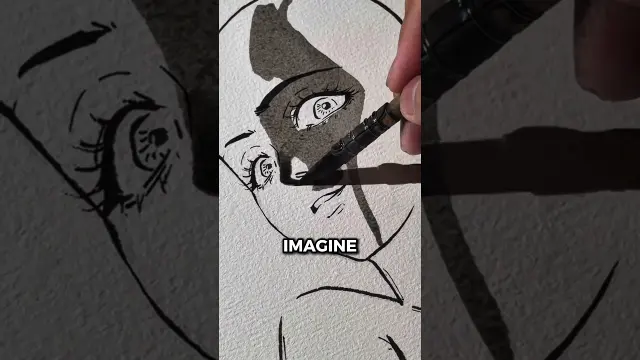
 Manga Portrait Shadowing and Inking Art Process
#Manga Art
1 ideas
Manga Portrait Shadowing and Inking Art Process
Get new #Manga Art ideas by email
Every Thursday: the week's best ideas, with the newest from #Manga Art.
Related tags
Manga Art: A Beginner's Guide to Drawing Comics
Manga art is the drawing style and visual grammar of Japanese comics, and one of the most widely recognised illustration languages in the world. Its roots lie in Japanese picture scrolls, woodblock prints and newspaper cartoons, and it took its modern shape over the twentieth century as serialised comics became a mass form of storytelling. What makes it distinctive is not a single way of drawing faces but a whole system of choices: how a story is broken into panels, how emotion is compressed into a gesture, how much is left unsaid.
How manga looks
Most manga is drawn in black and white and printed on cheap paper, so the drawing has to work without colour. Artists build images from line alone, using ink, hatching, solid blacks and halftone patterns. Colour is usually reserved for covers and special pages. This economy is part of the appeal: a page can be dense with detail or almost empty, and both can feel deliberate.
The main kinds
Read more
Manga is usually grouped by audience and tone rather than by subject. Shonen stories lean towards action, rivalry and growth; shojo titles tend towards romance and interior feeling, with airier layouts and decorative elements; seinen and josei work address older readers with slower, more realistic pacing; gekiga pushes towards gritty, cinematic realism. These labels describe a mood and a readership, not a rulebook, and plenty of artists move freely between them.
Techniques worth knowing
- Line weight carries meaning: a heavier contour holds a figure together, a thin line suggests lightness or delicacy.
- Screentone, whether a printed sheet or a digital pattern, adds grey, texture and shadow without paint.
- Backgrounds set the emotional temperature: speed lines and radiating strokes for tension, soft floral or abstract washes for introspection.
- Panels control time. Wide panels feel slow, small stacked panels feel quick, and a full-page spread stops the reader entirely.
- Japanese manga is read right to left, so panel order and page flow follow that direction.
Starting out
Learn the fundamentals of anatomy and perspective before stylising them; exaggeration reads best when it is built on something observed. Draw from life, and study pages you admire by copying them closely, asking yourself why each panel was placed where it is. Write a rough thumbnail of the page before inking anything, so the reading order is clear before you commit. Keep a model sheet for your characters with their expressions and proportions, so they stay recognisable from panel to panel. A dip pen, a brush pen and a set of tones are enough to begin, though a tablet and drawing software now offer the same tools with an undo button.
Finally, expect style to arrive on its own. The artists whose work lasts are rarely the most technically polished; they are the ones whose pages you can recognise at a glance because their choices, however simple, are consistent and honest.
#Manga Art: frequently asked questions
Do I need to know how to draw realistically before I can draw manga?
Yes, and it will make your stylised work stronger. Learn basic anatomy and perspective first, then exaggerate from something you have actually observed, because distortion only reads as intentional when it sits on a believable structure. Drawing from life is the fastest way to build that base.
Which kind of manga should I make if I'm not sure where I fit?
Think about the mood and reader you have in mind rather than picking a genre label. Shonen leans toward action and rivalry, shojo toward romance and interior feeling, while seinen and josei assume a slower, more grounded pace. These are descriptions of tone rather than rules, so many artists move between them freely.
What supplies do I actually need to start?
A dip pen, a brush pen and some screentone sheets will cover the traditional basics, and black ink on ordinary paper is genuinely enough. A tablet with drawing software offers the same tools with an undo button, which is friendlier while you are learning. Start simple and add supplies as a specific need appears.
How do I keep a character looking the same from panel to panel?
Make a model sheet for each character showing their proportions and a range of expressions, and keep it beside you while you draw. Consistency comes from repeated decisions rather than perfect rendering, so decide early how you handle hair, eyes and silhouette. Readers recognise a character by those few consistent choices.
What are the common mistakes beginners make with manga pages?
The most frequent one is inking before working out the reading order, which leaves panels that confuse the eye. Sketch a rough thumbnail of the whole page first so the flow is clear, and remember that the page reads right to left if you are following Japanese conventions. Another common slip is treating every panel with the same weight, when varying panel size is what controls pacing.
How should I store or handle finished manga artwork?
Keep pages flat, dry and out of direct light, since ink and tone sheets are sensitive to moisture and fading. Handle them by the edges where you can, and store loose pages between rigid boards rather than rolled or folded. If you scan your work, do it before any mounting or trimming so you keep a clean copy.
Videos come from YouTube and posts from Instagram; titles and summaries are our own. All rights belong to their creators.