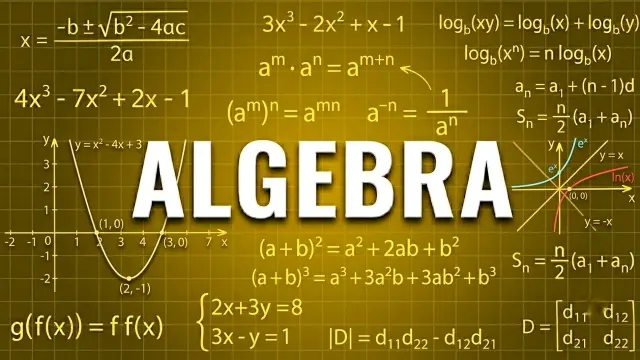
 Complete Comprehensive Guide Explaining All of Algebra
#Math Course
1 ideas
Complete Comprehensive Guide Explaining All of Algebra
Get new #Math Course ideas by email
Every Thursday: the week's best ideas, with the newest from #Math Course.
Related tags
Understanding a Math Course
A math course is a structured way of learning how numbers, patterns, shapes, quantities, and relationships work. It can range from basic arithmetic to advanced subjects such as algebra, geometry, calculus, statistics, or applied mathematics. At its core, mathematics is a language for describing order and change, and a good course helps you read that language step by step.
What a math course usually includes
Most math courses build from simple ideas to more complex ones. Early topics often cover counting, addition, subtraction, multiplication, division, fractions, decimals, and percentages. Later courses may focus on algebra, where you learn to use symbols and equations to represent unknown values. Geometry introduces lines, angles, shapes, and measurement. Other branches may include statistics, which deals with data and chance, and calculus, which studies change and motion in a precise way.
A course may also include problem solving, logic, and reasoning. These skills matter just as much as memorizing formulas, because mathematics is about understanding why a method works, not only how to use it.
Read more
Main kinds of math courses
The exact structure depends on your level and goals. Some common kinds are:
- Foundational math: basic number skills, fractions, ratios, and measurement
- Algebra: equations, expressions, functions, and graphs
- Geometry: shapes, area, volume, proofs, and spatial reasoning
- Trigonometry: angles, triangles, and relationships between sides
- Statistics and probability: interpreting data and understanding chance
- Calculus and higher mathematics: change, rates, limits, and advanced modeling
If you are beginning, it helps to learn each topic in order, because later ideas often rely on earlier ones.
How to study math effectively
Math improves with regular practice. Short, steady study sessions are often more useful than rare long ones. Work through examples slowly, and make sure you understand each step before moving on. If you make a mistake, treat it as part of the process: errors often show exactly where your understanding needs strengthening.
A few practical habits can help:
- Write out each step instead of doing everything in your head
- Review earlier topics often, especially fractions and algebra basics
- Learn the meaning of formulas, not just the final answer
- Check your work by estimating or using a different method
- Ask questions when a step feels unclear
What beginners should remember
It is normal for math to feel difficult at first, especially if new ideas build on one another. Try not to rush. Confidence usually grows when you see that most problems follow patterns. If you learn the basic rules well, more advanced topics become much easier to handle.
A math course is not only about getting correct answers. It also teaches patience, precision, and clear thinking. Those habits are useful far beyond the classroom, whether you are studying science, managing money, measuring materials, or simply making better decisions in everyday life.
Videos come from YouTube and posts from Instagram; titles and summaries are our own. All rights belong to their creators.