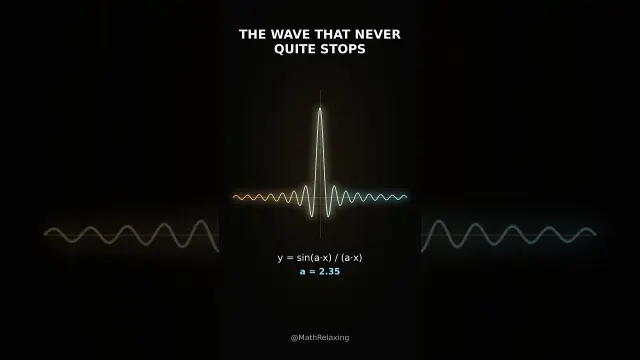
 The Sinc Function Squeezed with Procedural Music
#Functions
2 ideas
The Sinc Function Squeezed with Procedural Music
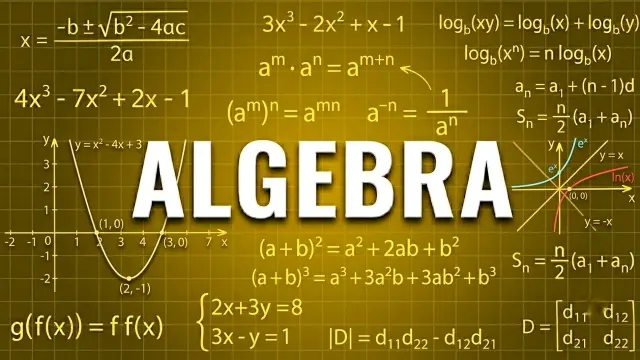 Complete Comprehensive Guide Explaining All of Algebra
Get new #Functions ideas by email
Every Thursday: the week's best ideas, with the newest from #Functions.
Related tags
Functions in Mathematics: A Clear Guide
What a function is
In mathematics, a function is a rule that connects one quantity to another. You can think of it as a machine: you give it an input, and it gives you exactly one output. That simple idea appears everywhere in algebra, geometry, calculus, and many applied fields.
Functions are used to describe relationships, such as how the height of a plant changes over time, how distance depends on speed and time, or how the value of one quantity depends on another. They are one of the most important ways mathematics turns patterns into something you can study clearly.
How functions are written
Read more
A function is often written with notation such as f(x). The letter f is the name of the function, and x is the input. If you see f(x) = x + 2, that means the function takes a number, adds 2, and returns the result.
The set of possible inputs is called the domain. The set of possible outputs is called the range, though people sometimes use the word image as well. A useful habit for beginners is to check the domain first, because not every input is always allowed.
Common types of functions
There are many kinds of functions, and each has its own shape and behavior.
- Linear functions: these have a constant rate of change and usually graph as straight lines.
- Quadratic functions: these often form a U-shaped curve called a parabola.
- Polynomial functions: these include powers of x and can have different shapes depending on their degree.
- Rational functions: these are ratios of polynomials and may have values that are not allowed.
- Exponential functions: these grow or shrink rapidly and are useful for change over time.
- Trigonometric functions: these describe repeating patterns and are common in geometry and physics.
Each type helps model different situations, so learning to recognize them is very helpful.
What to look for in a function
When you study a function, it helps to ask a few simple questions:
- What are the inputs and outputs?
- Is every input allowed?
- Does the function increase, decrease, or stay constant?
- Where does it cross the axes?
- Is the graph smooth, curved, repeating, or made of separate pieces?
These questions help you understand both the formula and the graph.
Tips for beginners
Start with small examples and read them carefully. If a formula looks confusing, replace the input with a simple number and work step by step. If you are drawing graphs, use a table of values first, then connect the points in a way that matches the function’s rule.
It also helps to remember that a function is not just a formula. A graph, a table, a verbal description, and an equation can all represent the same relationship. Being able to move between these forms is a key skill in mathematics.
Why functions matter
Functions are one of the core ideas that make higher mathematics possible. They help you describe change, compare quantities, and build models of real situations. Once you understand functions, many other topics become easier to read and use.
Videos come from YouTube and posts from Instagram; titles and summaries are our own. All rights belong to their creators.