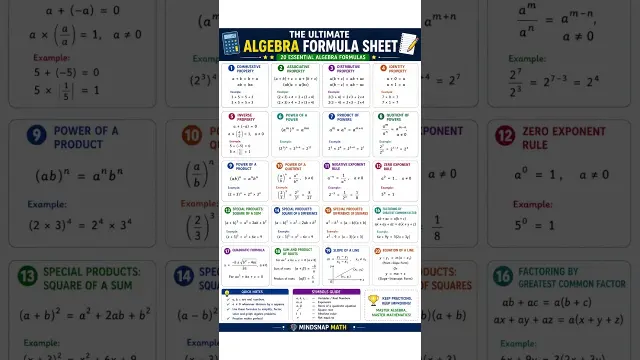
 Twenty essential algebra formulas for quick exam revision
#Math Study Aid
1 ideas
Twenty essential algebra formulas for quick exam revision
Get new #Math Study Aid ideas by email
Every Thursday: the week's best ideas, with the newest from #Math Study Aid.
Related tags
Math Study Aids: A Guide to Learning Tools
A math study aid is any tool or resource that helps you learn, remember or practise mathematics outside the moment of instruction. The idea is simple: mathematics is cumulative and unforgiving of gaps, so anything that shortens the distance between "I have seen this" and "I can do this unaided" earns its place. Study aids have existed as long as mathematics has been taught, from clay tablets of worked problems to the printed tables and slide rules that once filled every classroom, and their forms keep changing while their purpose stays the same.
The main kinds of study aid
The most familiar is the reference sheet: formulas, identities, definitions and unit conversions gathered in one place. A good one is not a substitute for understanding, but it frees you from memorising notation so you can concentrate on reasoning.
Flashcards work well for the pieces of mathematics that must simply be known — multiplication facts, derivative rules, trigonometric values, vocabulary such as "integer" or "coefficient". Spaced repetition, where cards you find difficult return more often than ones you find easy, makes this far more efficient than rereading a list.
Read more
Worked examples show a complete solution step by step. Their value lies in the commentary: why this substitution, why this factorisation, what made this approach the natural one. Reading a worked solution passively teaches very little; covering the answer and attempting it first teaches a great deal.
Practice sets and problem collections build fluency, and study guides or revision summaries condense a whole syllabus into a structure you can hold in your head. Diagrams, graph paper, geometry tools and physical models help visual and tactile learners see what the symbols describe.
What beginners should know
Start by diagnosing where the difficulty actually lies. Mathematics fails forward: if fractions or negative numbers are shaky, algebra will feel impossible no matter how many formulas you copy out. A study aid aimed at the wrong level wastes time.
Then use aids actively. Copying a formula sheet is close to useless; rewriting it from memory, or explaining a rule aloud to someone else, is not. Attempt problems before checking solutions, and when you check, ask what you would have needed to notice.
Keep aids short. A reference sheet you can skim in a minute gets used; forty pages do not. Revise your own notes into your own words, because the act of compressing is where much of the learning happens.
Practical habits
Study in short, regular sessions rather than long rare ones, since mathematical recall improves with repeated retrieval. Mix problem types rather than drilling one kind in a block, so you learn to recognise which method applies. Keep an error log: a running list of mistakes and their causes is one of the most effective aids of all, because it is tailored precisely to you.
Finally, treat aids as scaffolding. Their goal is to become unnecessary.
#Math Study Aid: frequently asked questions
How do I start using a math study aid if I'm not sure what I'm doing wrong?
Begin by working out where the difficulty actually comes from rather than picking up the first aid you find. Mathematics builds forward, so shakiness with earlier material such as fractions or negative numbers will make later topics feel impossible no matter how many formulas you copy out. Choose an aid that targets the level you are actually at, not the level you are supposed to be at.
Which kind of math study aid should I choose — a formula sheet, flashcards or practice problems?
It depends on what you are trying to fix. A reference sheet frees you from memorising notation so you can concentrate on reasoning, flashcards suit facts that simply must be known, and worked examples and problem sets build the ability to solve unaided. Many learners do best combining a short sheet with regular practice rather than relying on one alone.
What do I need to make a study aid actually work?
Mostly the willingness to use it actively rather than passively. Copying a formula sheet teaches very little, but rewriting it from memory or explaining a rule aloud to someone else does. Attempt problems before checking the solution, and when you do check, ask what you would have needed to notice.
How do I get the most out of worked examples without just reading them?
Cover the answer and try the problem yourself first, even if you get stuck partway. The real value of a worked example is the commentary around it: why this substitution or factorisation, and what made this approach the natural one. Reading a finished solution feels productive but leaves you able to recognise the method rather than produce it.
How should I look after a study aid over a term so it stays useful?
Keep it short and keep it yours. A sheet you can skim in a minute gets used while a long one gets abandoned, and revising notes into your own words is where much of the learning happens. Revisit and rewrite it regularly so it reflects what you now find difficult rather than what you found difficult at the start.
What common mistakes should I avoid when using math study aids?
The biggest is aiming at the wrong level, which quietly wastes time while feeling like effort. Another is treating aids as a substitute for understanding rather than scaffolding that should eventually become unnecessary. Drilling one problem type in a long block also backfires, since mixing types teaches you to recognise which method applies.
Videos come from YouTube and posts from Instagram; titles and summaries are our own. All rights belong to their creators.