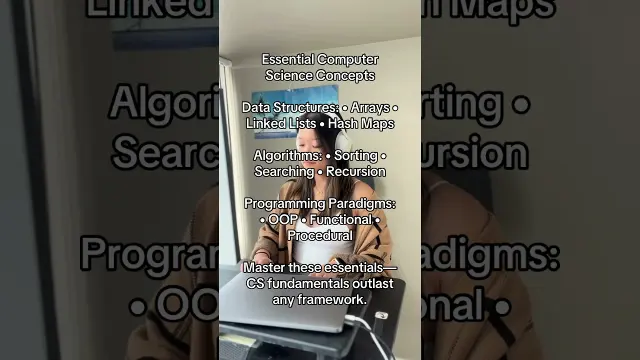
 Core Computer Science Fundamentals That Outlast Any Framework
#Programming Paradigms
1 ideas
Core Computer Science Fundamentals That Outlast Any Framework
Get new #Programming Paradigms ideas by email
Every Thursday: the week's best ideas, with the newest from #Programming Paradigms.
Related tags
Programming Paradigms: A Plain Guide to the Main Styles
A programming paradigm is a way of thinking about a program before you write a single line of it. It is not a language and not a library. It is a set of assumptions about what a program is made of — whether that is a sequence of instructions, a collection of objects that talk to each other, or a chain of expressions evaluated for their results — and what problems should be solved with which tools. Two programmers can write the same feature in two languages, or even in the same language, and disagree completely about how it should be structured, because they are working inside different paradigms.
Why the idea exists
The word comes from the study of how knowledge is built, and it entered computing as a way to name the big families of approaches that grew up alongside the first high-level languages. Once programs became large enough to be written by teams and read by strangers, it stopped being obvious what a program should look like. Paradigms are the accumulated answers to that question. Naming them lets people argue about design clearly instead of trading opinions about style.
The main families
Read more
- Imperative. A program is a list of steps that change the state of the machine. You say how to do something, in order. Most code written today is at least partly imperative.
- Procedural. A refinement of the imperative idea: steps are grouped into reusable procedures or functions, and data is passed between them. It is the natural first paradigm for most beginners.
- Declarative. You describe the result you want and leave the how to the system underneath. Query languages and configuration formats are the clearest examples.
- Functional. Computation is treated as the evaluation of expressions, with functions as the main building blocks, and with a strong preference for values that do not change once created.
- Object-oriented. A program is a set of objects that hold their own data and expose behaviour, communicating by messages or method calls. It dominates large application design for reasons of organisation as much as elegance.
- Logic. You state facts and rules, and the system searches for answers that satisfy them. It is less common in everyday work but shapes how many people think about problem solving.
What beginners should know
You do not have to pick a side. Nearly every widely used language today is multi-paradigm: it lets you write procedures, objects and functions in the same file. That is a feature, not a failure of nerve. What matters is recognising which style a piece of code is written in, so that you follow its conventions instead of fighting them.
Start with whatever your first language makes easy, and learn one paradigm properly rather than skimming five. Depth transfers; surface familiarity does not.
Practical tips
Keep data and the code that changes it close together, in whatever style you choose. Prefer small pieces with clear names over clever pieces with none. When a design feels awkward, ask whether you are applying the wrong paradigm rather than the wrong syntax. Read code from other traditions on purpose — a functional solution to a problem you solved imperatively teaches more than another tutorial in the style you already know. And remember that paradigms are tools for managing complexity, not badges of identity.
The best structural choice is usually the one the next person can follow without a meeting.
#Programming Paradigms: frequently asked questions
How do I start learning programming paradigms?
Begin with the style your first language makes easiest — usually procedural code that groups steps into reusable functions — and get comfortable with it before moving on. Once that feels natural, pick one other paradigm and study it properly rather than sampling many. Depth in a single approach transfers to the next one far better than surface familiarity with several.
Do I need to choose one paradigm and stick to it?
No. Most languages in everyday use are multi-paradigm, so you can write procedures, objects and functions side by side in the same file. What actually matters is recognising which style a given piece of code is written in, so you follow its conventions instead of fighting them. Paradigms are tools for managing complexity, not identities to defend.
Which paradigm should I use for a new project?
Look at the shape of the problem: if it is a sequence of transformations, favour functions and expressions; if it is a system of related things that carry their own data, favour objects. The best structural choice is usually the one the next person can follow without needing a meeting. If a design starts feeling awkward, question whether the paradigm is wrong before blaming the syntax.
What are the most common mistakes people make when learning paradigms?
The usual one is skimming many styles instead of learning one well, which leaves you able to name paradigms but not apply them. Another is treating a paradigm as a badge of identity and rewriting working code to prove a point. A third is forcing a familiar approach onto a problem that clearly suits another one.
How do I keep up with paradigms as new frameworks appear?
Focus on the underlying fundamentals of computation rather than on any single framework, since those ideas outlast the tools built on top of them. Deliberately read code written in traditions other than your own — a functional solution to a problem you solved step by step teaches more than another tutorial in the style you already know. Over time you will spot which family a new framework belongs to and learn it faster.
Videos come from YouTube and posts from Instagram; titles and summaries are our own. All rights belong to their creators.