 What Q-Day Means for Encryption and Everyday Digital Privacy
#Q-Day
2 ideas
What Q-Day Means for Encryption and Everyday Digital Privacy
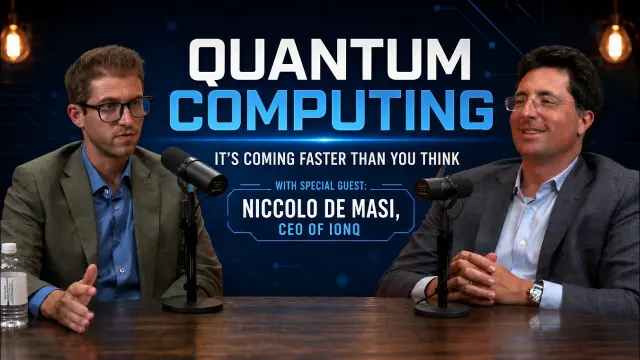 IonQ CEO Niccolo de Masi on Quantum Computing and Q-Day
Get new #Q-Day ideas by email
Every Thursday: the week's best ideas, with the newest from #Q-Day.
Related tags
Q-Day: What Quantum Computing Means for Encryption
Q-Day is the shorthand name for a milestone nobody has reached yet: the moment a quantum computer becomes capable of breaking the public-key cryptography that quietly protects most of digital life. It is not a product, a company or an event with a date. It is a way of talking about a risk that is easy to postpone and hard to repair once it arrives.
Where the name comes from
The expression grew up in cryptography and security circles, borrowing the habit of naming long-feared turning points with a letter and a word. The "Q" stands for quantum; the rest signals a threshold rather than a schedule. Researchers use it as a placeholder for "some point, sooner or later, when the maths underneath our security stops holding".
What actually breaks
Read more
Modern encryption comes in families. Symmetric ciphers, which use one shared key, are weakened but not destroyed by quantum hardware; the usual answer is simply to use longer keys. The fragile part is public-key cryptography, the kind used for key exchange and digital signatures. It rests on problems believed to be hard for ordinary computers, such as factoring very large numbers or solving certain discrete logarithms. A sufficiently large quantum machine could attack those problems in a fundamentally different way, and the foundations would no longer hold.
That matters because public-key cryptography is everywhere you are not looking: the padlock on a website, software updates, banking messages, digital identity documents, code signing, secure messaging setup. Signatures are as important as secrecy, since a forged signature can make malicious software look legitimate.
Harvest now, decrypt later
The uncomfortable part is timing. Encrypted traffic can be recorded today and stored, in the hope that it becomes readable later. Anything that must stay secret for a decade or more, from medical records to diplomatic cables to trade secrets, is already exposed in principle, even if the machine that reads it does not exist yet. This gap between "starts mattering" and "becomes possible" is why security people talk about Q-Day years in advance.
The main responses
- Post-quantum cryptography: new mathematical schemes, chosen and reviewed openly by international standards bodies, that run on ordinary computers and are thought to resist quantum attack.
- Quantum key distribution: using the physics of quantum communication itself to exchange keys, with different practical limits and costs.
- Hybrid modes: running a classical and a post-quantum method together so that a flaw in either one alone is not fatal.
What beginners should take from it
Nobody can tell you when Q-Day comes, and anyone who quotes a confident date is guessing. The useful idea is not the date but the lead time: replacing cryptography across large systems is slow, and long-lived secrets need protecting first. Start by asking where public-key cryptography is used in your world, prefer tools that can swap algorithms without a rebuild, and treat guidance from standards bodies as the practical reference. Calm, unhurried preparation is exactly what this topic rewards.
#Q-Day: frequently asked questions
What exactly is Q-Day, and does it have a date?
It is a label for the moment a quantum computer becomes able to break the public-key cryptography quietly protecting most digital traffic — a threshold, not a product launch or a scheduled event. Nobody can tell you when it arrives, and a confident prediction is really just a guess. It is more useful to treat it as something to prepare for than as a countdown to watch.
How should a beginner start preparing for Q-Day?
Start with an inventory: find where public-key cryptography is actually used in your world — the padlock on a website, software updates, identity documents, secure messaging setup, code signing. Then prefer tools that let algorithms be swapped out without rebuilding everything around them. Guidance from standards bodies is the practical reference to work from.
Which approach is better — post-quantum cryptography or quantum key distribution?
Post-quantum cryptography is usually the first step, because those schemes run on ordinary computers and are chosen and reviewed openly by international standards bodies. Quantum key distribution leans on the physics of quantum communication to exchange keys, which brings its own practical limits and costs. Hybrid modes run a classical and a post-quantum method side by side so a flaw in either one alone is not fatal, which is why many teams start there.
What should be protected first?
Anything that must stay confidential for a long time: records, private correspondence, trade secrets, identity information. Encrypted traffic can be recorded today and stored in the hope of becoming readable later, so the exposure begins well before the machine that could read it exists. Prioritise by how long the secret has to hold, not by how soon the threat might arrive.
What mistakes do people commonly make about Q-Day?
The first is waiting for a fixed date instead of working on lead time, since replacing cryptography across large systems is slow. The second is assuming this is only about secrecy — signatures matter just as much, because a forged signature can make malicious software look legitimate. A third is designing around a single algorithm rather than choosing systems that can change.
Does Q-Day break all encryption?
No. Symmetric ciphers, which use one shared key, are weakened rather than destroyed, and the usual response is simply to use longer keys. The fragile part is public-key cryptography, the kind used for key exchange and digital signatures, which rests on problems a sufficiently large quantum machine could attack in a fundamentally different way.
Videos come from YouTube and posts from Instagram; titles and summaries are our own. All rights belong to their creators.