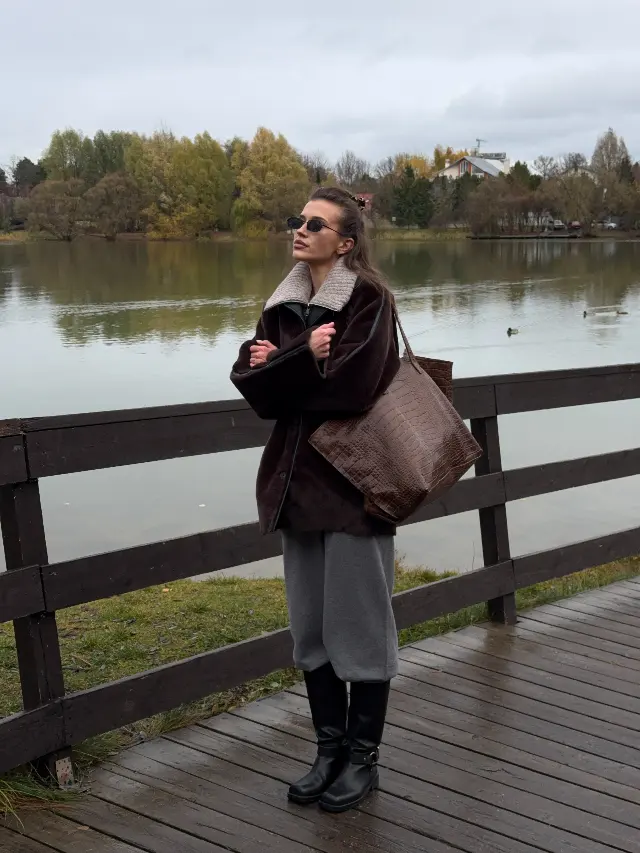
 Cozy Autumn Weekend Outfit With Jacquemus Scarf and Ankle Boots
#Scarf Styling
3 ideas
Cozy Autumn Weekend Outfit With Jacquemus Scarf and Ankle Boots
Get new #Scarf Styling ideas by email
Every Thursday: the week's best ideas, with the newest from #Scarf Styling.
Related tags
Scarf Styling: A Guide to Knots, Drapes and Everyday Looks
A scarf is one of the simplest pieces of cloth in a wardrobe and one of the most versatile. A rectangle or square of fabric, hemmed at the edges, it has no sleeves, no sizing and no fixed purpose — which is exactly why it can be worn so many ways. Across cultures and centuries it has served as protection from cold, sun and dust, as a marker of dress or ceremony, and as an easy way to add colour and texture to an otherwise plain outfit. Its usefulness outlives any particular fashion.
Fabrics and shapes
The material decides how a scarf behaves. Silk and satin are light and fluid, they drape closely and hold a crisp knot, and they suit indoors and warm weather. Cotton and linen are matte and breathable, good for everyday wear and for tying in the hair. Wool, cashmere and blends are warmer and bulkier, which makes them suited to loose wraps and simple loops rather than tight knots. Synthetic blends vary widely, so feel the fabric before you commit: a scarf that slips will not hold a knot, and one that is stiff will not drape.
Shapes matter as much as fabric. A long rectangular scarf is the easiest to work with and gives the most length for wrapping. A large square is the classic for folding into a triangle, tying at the neck or covering the head. A small square, often called a bandana or neckerchief, is made for compact, tidy knots and hair ties.
Read more
Basic techniques
Almost every scarf look comes from a handful of moves. Fold the scarf in half lengthwise for a neat band, or diagonally for a triangle. Then try the simple loop: drape it around the neck, cross the ends once, and let them hang. The knot: bring the ends to the front and tie once, loosely. The Parisian knot: fold the scarf in half lengthwise, drape the folded loop around the neck and pull the two loose ends through that loop, then tighten gently. Do the same with a square folded into a triangle and you have a neat, close-fitting drape. For the head, fold a square into a triangle and tie the ends at the nape. In the hair, a narrow folded strip works as a headband or tied around a ponytail.
Good to know
Contrast is what makes styling work: a patterned scarf over a plain outfit, a soft fabric against a structured coat, a bright colour near the face. Pay attention to proportion — a bulky wool scarf overwhelms a delicate collar, while a small silk square disappears under a heavy coat. Keep the knot comfortable, especially at the neck, and avoid tying anything tightly.
Care keeps a scarf wearable for years. Wash according to the fibre, dry flat when the fabric is delicate, and store silk folded rather than hung to prevent stretching. If a knot has left a crease, a light steam usually smooths it.
Start with one long neutral scarf and one patterned square. Practise three knots in front of a mirror until they feel natural, and you will find that the same piece can carry an outfit from morning to evening.
#Scarf Styling: frequently asked questions
How do I start styling a scarf if I’m a beginner?
Start with one long neutral scarf and one square scarf so you can practice different looks without feeling overwhelmed. Begin with simple folds and knots in front of a mirror, like a loose loop, a basic tie, or a triangle fold, until the shape feels natural.
What kind of scarf is easiest to style?
A long rectangular scarf is usually the easiest because it gives you more length for wrapping and knotting. A large square is also very versatile since it can be folded into a triangle, tied at the neck, or worn on the head.
Which scarf material should I choose for my outfit?
Choose the fabric based on how you want the scarf to behave. Silk and satin drape smoothly and suit polished looks, while cotton and linen feel lighter and work well for everyday wear or hair styling. Warmer fabrics like wool or cashmere are better for loose wraps and cozy layering.
How can I wear a scarf for a classy or elegant look?
For a more elegant style, keep the scarf close to the outfit and let the fabric do the work. A silk or satin scarf tied neatly at the neck, a simple loop over a coat, or a softly folded square can add color and polish without looking busy.
Can I use a scarf in my hair or as an accessory for a casual outfit?
Yes, a scarf works well as a headband, a ponytail tie, or a bandana-style wrap. Smaller squares or narrow folded strips are especially useful for this because they create tidy, secure shapes that feel easy and casual.
How do I care for a scarf so it lasts longer?
Wash it according to the fabric and handle delicate materials gently. Let fragile scarves dry flat, store silk folded instead of hanging it, and use light steam to smooth out creases after tying.
Videos come from YouTube and posts from Instagram; titles and summaries are our own. All rights belong to their creators.