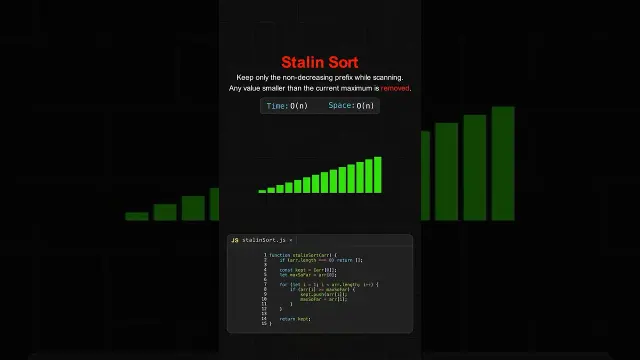
 Implementing the Brutal Stalin Sort Algorithm in JavaScript
#Sorting Algorithms
2 ideas
Implementing the Brutal Stalin Sort Algorithm in JavaScript
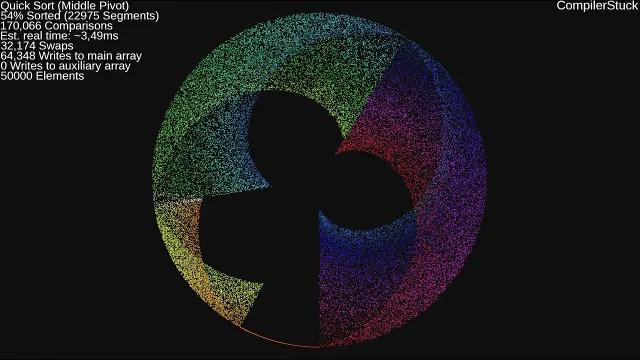 Visualizing Twenty Different Sorting Algorithms with Polar Coordinates
Get new #Sorting Algorithms ideas by email
Every Thursday: the week's best ideas, with the newest from #Sorting Algorithms.
Related tags
Sorting Algorithms Explained
Sorting algorithms are methods for arranging items in a particular order, usually from smallest to largest or from A to Z. In computing, they are essential because ordered data is easier to search, compare, and process. Sorting also appears in everyday thinking, from organizing books by title to lining up tasks by priority.
What sorting algorithms do
A sorting algorithm takes a list of values and rearranges them according to a rule. The items can be numbers, words, dates, or anything that can be compared. Some algorithms are designed to be simple and easy to understand, while others are built for speed, efficiency, or handling large amounts of data.
The choice of algorithm depends on the size of the list, whether the data is already partly ordered, and whether you want the sort to preserve the original order of equal items. That last point is called stability.
Read more
Main kinds of sorting algorithms
There are several classic families of sorting algorithms:
- Comparison-based sorts: These compare items two at a time and decide which comes first. Examples include bubble sort, insertion sort, selection sort, merge sort, quicksort, and heapsort.
- Non-comparison sorts: These use properties of the data itself, such as digits or ranges of values. Examples include counting sort, radix sort, and bucket sort.
- Stable sorts: These keep equal items in their original relative order, which can matter when sorting by more than one field.
- Unstable sorts: These may change the order of equal items, which is sometimes acceptable if speed or memory use is more important.
Common techniques
Some sorting methods work by repeatedly swapping neighboring items until the list settles into order. Others divide the list into parts, sort each part, and then combine them. Some build the sorted list gradually by inserting each new item in the right place. Others rely on a tree-like structure or on counting how many times each value appears.
Each approach has strengths and weaknesses. Simple methods are often easier to learn, but they can be slow on long lists. More advanced methods usually perform better on large data sets, though they may be harder to follow at first.
What beginners should know
If you are learning sorting algorithms, start by understanding how each one moves items around. Try tracing a short list by hand. This makes the logic much clearer than reading code alone.
A few useful ideas to keep in mind:
- Time matters: some algorithms need many more comparisons than others.
- Space matters too: some sorts use extra memory, while others work in place.
- Input shape matters: a nearly sorted list may be handled very efficiently by some algorithms.
- Stability can matter if you sort by more than one criterion.
Practical tips
When choosing a sorting algorithm, think about simplicity first, then efficiency. For small lists or learning purposes, a straightforward algorithm may be enough. For larger lists, it helps to choose one known for better average performance. If your data has a limited range, a non-comparison method may be useful.
Sorting is one of the most important ideas in computer science because it sits at the intersection of logic, structure, and performance. Learning a few different algorithms gives you a stronger sense of how data can be organized, compared, and transformed.
Videos come from YouTube and posts from Instagram; titles and summaries are our own. All rights belong to their creators.