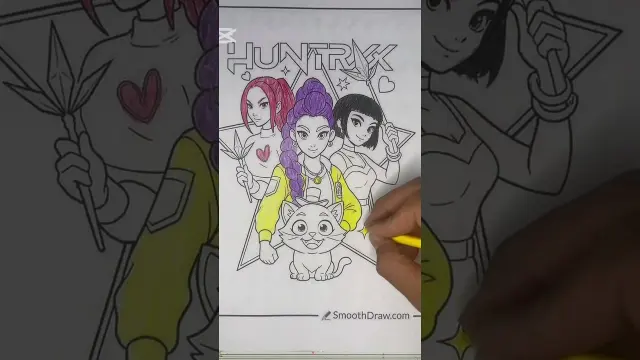
 K-Pop Character Fan Art Coloring and Speed Drawing Process
#Speed Drawing
1 ideas
K-Pop Character Fan Art Coloring and Speed Drawing Process
Get new #Speed Drawing ideas by email
Every Thursday: the week's best ideas, with the newest from #Speed Drawing.
Related tags
Speed Drawing: Fast, Expressive Art Practice
Speed drawing is the practice of making a drawing quickly, with attention on capturing the essential idea rather than perfect detail. It is used by illustrators, designers, concept artists, and hobbyists alike, both as a warm-up and as a way to train the eye and hand to work together more freely. The result is often lively, energetic, and full of motion, even when the lines are simple.
What speed drawing is
At its core, speed drawing is about working under a time limit or with a deliberate sense of urgency. You may be drawing a person, an animal, an object, or a scene, but the aim is the same: to find the main shapes, proportions, and expression quickly. This makes it especially useful for learning to simplify. Instead of getting stuck on tiny details too early, you practice seeing the big picture first.
Speed drawing has long been part of art training in different forms. Figure studies, gesture drawing, and quick sketching have all served similar purposes: building observation skills and helping artists become more decisive. In modern practice, speed drawing can be done with pencil, pen, markers, or digital tools.
Read more
Common kinds of speed drawing
There are several ways to approach it:
- Gesture drawing: very short sketches that capture movement, pose, and energy
- Timed sketching: drawing an object or figure within a set time limit
- Speed painting or digital speed drawing: a quick, loose image built in layers
- One-line or minimal-line studies: reducing the subject to a few clear marks
- Repeated practice drawings: drawing the same subject several times to improve speed and confidence
Each approach teaches something slightly different. Gesture work helps with movement, while timed sketching helps with decision-making and proportion.
What beginners should know
If you are new to speed drawing, try not to judge your work by how finished it looks. The purpose is practice, not perfection. Start with simple subjects such as mugs, shoes, plants, hands, or face shapes. These help you learn to spot structure without becoming overwhelmed.
A few helpful habits:
- Begin with the largest shapes first
- Keep your lines light at the start if you are using pencil
- Focus on proportion and placement before details
- Accept imperfect drawings as part of the process
- Repeat the same exercise often to build confidence
It can also help to use a reference. Looking at a real object or photo trains your eye to compare angles, shapes, and spacing more accurately. Over time, you will likely notice that your hand becomes quicker and your sketches feel more natural.
Practical tips
Speed drawing works best when you stay relaxed. If you tense up, your lines may become stiff and hesitant. Try to move your whole arm when needed, and avoid erasing too much if you want to keep the drawing fresh. A drawing that is slightly rough but alive is often more useful than one that is overworked.
You can also set small goals: capturing posture in one minute, adding structure in five minutes, or finishing a simple study in ten. The time limit encourages clarity and helps you notice what really matters in a subject. With regular practice, speed drawing can sharpen your observation, improve your confidence, and make your drawings feel more immediate and expressive.
#Speed Drawing: frequently asked questions
How do I start speed drawing if I've never tried it?
Pick a simple everyday object or a person sitting nearby and give yourself a short, fixed time limit to capture it. Start with the largest shapes and overall placement before you think about details, and let the drawing stay rough. The point is to train your eye and hand to work together, so treat the first attempts as exercise rather than finished artwork.
What supplies do I actually need for speed drawing?
Almost anything that makes a mark will do: a pencil, a pen, markers, or a digital tablet with a drawing app. What matters more than the tool is that it lets you work fast without fussing, so avoid anything that slows you down or makes you tentative. A reference, either a real object or a photo, helps your eye compare shapes and spacing accurately.
Which kind of speed drawing should I choose?
It depends on what you want to improve. Gesture drawing with very short sketches builds a sense of movement and pose, timed sketching sharpens proportion and quick decisions, and minimal-line or one-line studies teach you to simplify. Try a few and keep the one that exposes your weakest habit.
What are the common mistakes beginners make?
The usual ones are chasing tiny details too early, tensing the hand so lines go stiff, and erasing so much that the drawing loses its energy. Judging each attempt by how finished it looks is another trap, since the purpose is practice and not a polished result. Keeping lines light at the start and accepting imperfect drawings will move you along faster.
How can I use speed drawing for a themed project or occasion?
Speed drawing works well as a warm-up before a bigger piece, as a way to explore several poses or compositions quickly, or as a shareable process video showing a character coming together from loose shapes to final lines. Fan art and character studies suit this especially well, because the energy of quick marks reads clearly on screen.
Do I need to care for speed drawing materials differently?
Not really, but a couple of habits help. Store pencils and pens so tips aren't crushed, keep sketchbook pages dry and flat so the paper doesn't buckle, and if you work digitally, save your files regularly in case a session runs long. Loose, fast work often means more pages and more sessions, so keeping your kit tidy saves time later.
Videos come from YouTube and posts from Instagram; titles and summaries are our own. All rights belong to their creators.