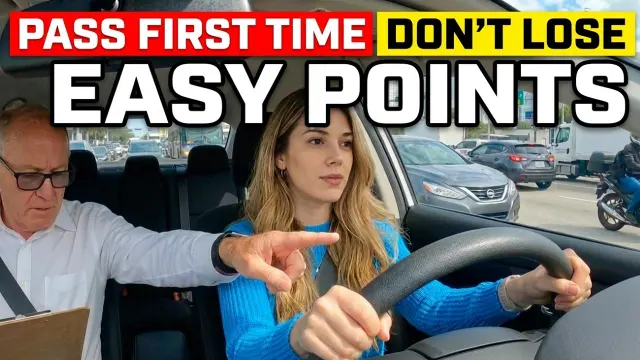
 Common Mistakes That Cost Points on the DMV Road Test
#Three-Point Turn
1 ideas
Common Mistakes That Cost Points on the DMV Road Test
Get new #Three-Point Turn ideas by email
Every Thursday: the week's best ideas, with the newest from #Three-Point Turn.
Related tags
Three-Point Turn: A Complete Guide to the Maneuver
A three-point turn is a driving maneuver that reverses your direction of travel on a road too narrow to turn around in a single sweep. Instead of one continuous arc, you move forward, back, and forward again — hence the name — using the width of the road to complete the change. Some drivers call it a K-turn or a Y-turn, because the path the car traces resembles those letters when viewed from above.
Why and when it is used
The maneuver exists for a simple reason: not every road has a driveway, junction, or wide mouth you can borrow to swing around. A quiet residential street, a narrow country lane or a dead end may leave no other option. A three-point turn is generally considered a last resort on busy roads, where a U-turn at a junction or simply continuing to a place where turning is easier is usually safer. Many places restrict turning around on curves, hills, bridges and stretches with limited visibility, so it is worth knowing what your local rules allow before you rely on the technique.
The basic sequence
Read more
The idea is to divide the turn into three movements, each one taking you as far as the space allows before you stop and reassess.
- Begin parked as close to the right-hand kerb as is safe, with your indicator on to warn anyone behind you.
- Check mirrors and blind spots, then turn the wheel fully and move forward slowly until you approach the opposite kerb, stopping before you reach it.
- Check again in both directions, select reverse, turn the wheel the other way and back up slowly toward the kerb behind you.
- Check once more, then drive forward with the wheel turned to complete the turn and straighten out in the new direction.
Everything happens at walking pace. The steering is the slow part; the observations are the constant. Between each movement, glance at both mirrors and over your shoulder, because the area behind you changes as the car rotates and a pedestrian or cyclist can appear in the gap you are about to cross.
What beginners should know
Most difficulty comes from the urge to rush. A turn taken in six slow, well-observed movements is safer and often faster overall than one rushed in three. Keep the car's wheels steady when you stop, and remember that turning the wheel while the car is stationary loads the steering and is discouraged.
Drivers of manual cars have an extra consideration: you will be changing between forward and reverse gears repeatedly, so keep clutch control smooth and be prepared to hold the car on a slight slope. In an automatic, the car may creep when you release the brake, so cover the brake pedal and move in short, controlled bursts.
Finally, remember that the maneuver is only as good as your judgement of the space. If traffic builds behind you or the road turns out to be tighter than expected, it is entirely acceptable to abandon the turn, straighten up and drive on to a safer spot. Knowing when not to attempt it is part of the skill.
#Three-Point Turn: frequently asked questions
How do I start a three-point turn without panicking in traffic?
Pull over as close to the kerb as you safely can, signal, and take a breath before you touch the wheel — the maneuver is done at walking pace, so nothing about it rewards hurrying. Check your mirrors and blind spots, then begin the first forward movement only when you are sure the road behind and ahead is clear. If cars start to gather, it is fine to wait for a gap rather than pushing on.
What do I need before attempting one, in terms of road and car?
You need a stretch of road wide enough for the car to swing across, with clear visibility in both directions and no rule against turning around there. Quiet residential streets, lanes and dead ends suit it; curves, hills, bridges and busy roads generally do not. Your car should be in good working order with responsive steering, and you should be comfortable with clutch or brake control at very low speed.
How do I know whether to do a three-point turn or find somewhere else to turn?
If there is a junction, driveway or wide mouth you can borrow nearby, using it is almost always the simpler and safer choice. The three-point turn is best kept as a fallback for genuinely narrow or empty roads where nothing else is available. On a busy road, driving on until turning is easy usually beats turning around in the traffic flow.
Any tips for keeping the car controlled while reversing in the middle of the turn?
Move in short, controlled bursts rather than one long sweep, and keep your foot covering the brake in an automatic since the car may creep once you release it. Turn the wheel only while the car is rolling — grinding it around while stationary strains the steering and gives you less feel for the space. Before each change of direction, look over your shoulder as well as in the mirrors, because the blind area shifts as the car rotates.
What are the most common mistakes people make during a three-point turn?
Rushing is the big one: a slow turn taken in more movements is both safer and often quicker overall than a hurried one. Forgetting to re-check blind spots after each change of direction is another frequent slip, since a cyclist or pedestrian can appear in the gap you are about to cross. Many drivers also fail to signal early or drift away from the kerb at the start, which leaves less room and makes the whole maneuver tighter than it needs to be.
When should I give up on the turn and just drive on?
If traffic builds up behind you, visibility worsens, or the road turns out narrower than you judged, straightening up and continuing is a perfectly good outcome. Abandoning the maneuver is part of the skill, not a failure of it — and it is far easier to do early than once you are halfway across the road. Pull yourself together, check the way is clear, and drive on to a spot where turning is straightforward.
Videos come from YouTube and posts from Instagram; titles and summaries are our own. All rights belong to their creators.