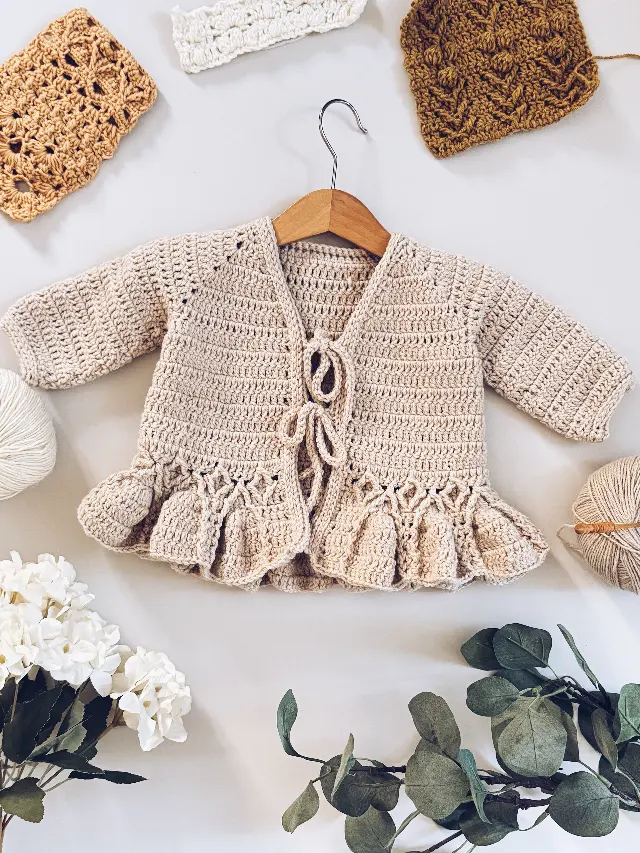
 Adeline Tie Cardigan: seamless top-down baby cardigan pattern
#V-Neck
1 ideas
Adeline Tie Cardigan: seamless top-down baby cardigan pattern
Get new #V-Neck ideas by email
Every Thursday: the week's best ideas, with the newest from #V-Neck.
Related tags
V-Neck Knitting Guide: Shaping, Styles and Tips
A V-neck is a neckline that dips to a point at the centre front, formed by two diagonal edges meeting in a V. In knitting it is less a single technique than a family of them: the shape can be made in several ways, and each gives a slightly different line, drape and level of difficulty. What they share is that the V is created by decreases worked along the front edges at regular intervals, so the fabric narrows gradually toward the point.
How the shape is made
Most V-necks rely on paired decreases. On a cardigan or a sweater knitted flat, you work a decrease a stitch or two in from each front edge, usually every few rows, until the shoulders are the right width. On a garment knitted in the round, the decreases sit either side of a centre front stitch. The spacing determines the depth and angle: frequent decreases make a wide, shallow V, while slower ones produce a narrow, deep plunge. Placing the decrease a stitch or two in from the edge leaves a tidy line of stitches to pick up later.
The main kinds
Read more
A set-in V-neck is shaped with decreases along an armhole and is common in fitted sweaters. A raglan V-neck runs the neckline diagonally into raglan armhole shaping, so the V and the shoulder slope meet. A top-down V-neck, worked from the neck opening downward, lets you try the garment on as you go and is popular in seamless cardigans and pullovers. There are also mock V-necks, which are shallower, and deep V-necks, which need attention to fit so the neckline does not gape.
Bands and finishing
The neckband is often picked up along the diagonal edges and knitted afterward, usually in ribbing, then joined at the point. Because the edge is on the bias, the band can pull tight or flare if the pick-up rate is uneven. Picking up roughly one stitch per row along the diagonals, and adjusting on a swatch first, gives a flatter result. A small overlap or a centred double decrease at the point keeps the V crisp.
What beginners should know
Start with a plain stockinette V-neck in a smooth yarn, where the decrease line is easy to see. Write down your decrease rows, or use a row counter, because the rhythm matters more than any single row. Swatch the neckline if you can: a few inches of the diagonal will tell you whether the angle suits you. Blocking opens the shape and evens the edges. Finally, remember the V is meant to sit flat when worn, so check the fit before you commit to the bind-off.
Once the basics are familiar, the same principles apply to finer yarns, deeper plunges and decorative decrease lines, and a simple V-neck becomes one of the most adaptable shapes in a knitter's repertoire.
#V-Neck: frequently asked questions
How do I start knitting my first V-neck?
Begin with a plain stockinette V-neck in a smooth yarn, because the diagonal decrease line stays easy to see and follow. Note down which rows carry your decreases, or keep a row counter, since the steady rhythm of shaping matters far more than any single row. Knit a small sample of the diagonal first if you can, so you know the angle suits you before you commit to the whole garment.
What do I need to know about the decreases that form the V?
The point is created by working decreases along the front edges at regular intervals, so the fabric narrows gradually toward the centre. On flat pieces you work a decrease a little in from each front edge; on pieces knitted in the round the shaping sits on either side of a centre front stitch. Leaving that small margin of stitches at the edge gives you a tidy line to pick up when the neckband goes on later.
Which kind of V-neck should I choose for a project?
A top-down V-neck is a good choice if you like to try the garment on as you go, and it suits seamless cardigans and pullovers. Set-in and raglan versions give a more tailored fit, with the raglan running the neckline diagonally into the armhole shaping so the V and shoulder slope meet. Shallower mock V-necks are easier to fit, while a deep plunge needs more attention so the neckline does not gape.
How do I keep the neckband from pulling or flaring?
The diagonal edge sits on the bias, so an uneven pick-up rate is what usually makes a band tight in places and wavy in others. Pick up along the diagonals at a fairly consistent rate, adjust on a sample first, and knit the band in ribbing so it holds its shape. A small overlap or a centred double decrease at the point helps keep the V crisp where the two sides meet.
What are the most common mistakes with a V-neck?
The usual trouble is uneven decrease spacing, which throws off the angle of the neckline and makes the depth hard to predict. Another is rushing the finishing: the band is picked up and knitted afterward, so a careless pick-up shows along the whole edge. Skipping blocking is the third, since blocking opens the shape and evens out the diagonals.
How should I care for a finished V-neck garment?
Hand wash in cool water with a gentle wool-friendly soap, avoid wringing or hanging it wet, and dry it flat and shaped so the neckline keeps its line. Store it folded rather than on a hanger, which stretches the shoulders and distorts the V. A light press or re-blocking after washing brings the edges back into shape.
Videos come from YouTube and posts from Instagram; titles and summaries are our own. All rights belong to their creators.