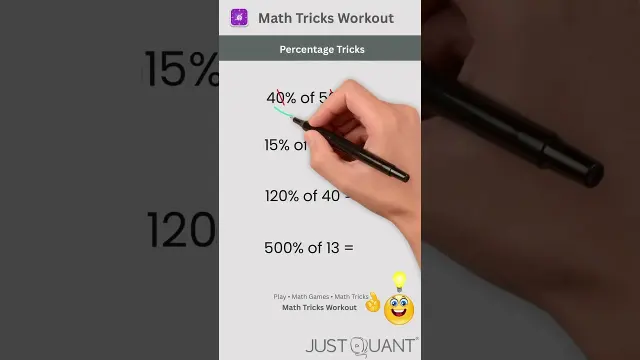
 Zero-Canceling Percentage Trick for Mental Math
#Fast Arithmetic
2 ideas
Zero-Canceling Percentage Trick for Mental Math
 Unique Tips and Shortcuts for Fast Mental Math
Get new #Fast Arithmetic ideas by email
Every Thursday: the week's best ideas, with the newest from #Fast Arithmetic.
Related tags
Fast Arithmetic and Mental Math
What fast arithmetic means
Fast arithmetic is the ability to do calculations quickly and accurately without relying on a calculator for every step. It includes mental math, written shortcuts, and practical ways of breaking numbers into easier parts. People use it in everyday life for shopping, cooking, budgeting, measuring, and checking whether an answer makes sense.
The idea is not to do everything in your head as fast as possible. It is to choose a method that is simple, reliable, and easy to remember. For many people, the real benefit is confidence: when numbers feel less intimidating, everyday decisions become easier.
Common techniques
Read more
A good place to start is with number relationships. If you know your basic addition, subtraction, multiplication, and division facts well, larger calculations become much easier. From there, a few useful habits can make a big difference.
One common method is breaking numbers apart. For example, you can add in parts, such as combining tens first and then ones. You can also multiply by splitting one factor into smaller pieces, like turning a hard problem into two easier ones.
Rounding is another helpful tool. If you need a quick estimate, round numbers to the nearest ten, hundred, or another convenient value, then adjust the result if needed. Estimation is especially useful when you want to check whether an exact answer is reasonable.
Mental math strategies
Some people prefer using patterns. Multiplying by 10, 100, or 1,000 is straightforward once you understand how place value works. Doubling and halving can also simplify many calculations. For example, one number may be easier to work with if you divide it by 2 while doubling the other.
Percentages often become easier when you think in fractions. Ten percent, five percent, and one percent are especially useful reference points. Once those are clear, you can build larger percentages from them.
Another classic strategy is compensation. If a number is close to a round figure, you can adjust the calculation. For example, adding 99 may be easier if you think of 100 and then subtract 1. This kind of adjustment can save time when done carefully.
Tips for beginners
Start with accuracy, not speed. If you rush before the method feels natural, mistakes become more likely. It helps to practice short exercises regularly rather than doing long sessions once in a while.
Use methods that suit the problem. Some questions are easiest with mental shortcuts, while others are better handled on paper. Fast arithmetic is not one single trick; it is a collection of habits you can choose from.
It also helps to estimate first and answer second. A rough estimate tells you whether your final result is sensible. If the exact answer is very different, you can check your steps again.
Building confidence with numbers
The best way to improve fast arithmetic is steady practice with everyday numbers. Try doing small calculations in your head during normal routines, such as splitting a bill, comparing prices, or working out time differences. Over time, these small efforts strengthen number sense.
Fast arithmetic becomes easier when you understand why the shortcuts work. Once the logic feels familiar, you can adapt it to many different problems instead of memorizing too many separate rules.
Videos come from YouTube and posts from Instagram; titles and summaries are our own. All rights belong to their creators.