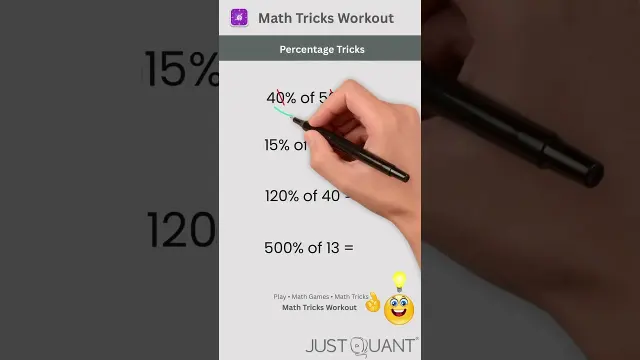
 Zero-Canceling Percentage Trick for Mental Math
#Percentage Tricks
3 ideas
Zero-Canceling Percentage Trick for Mental Math
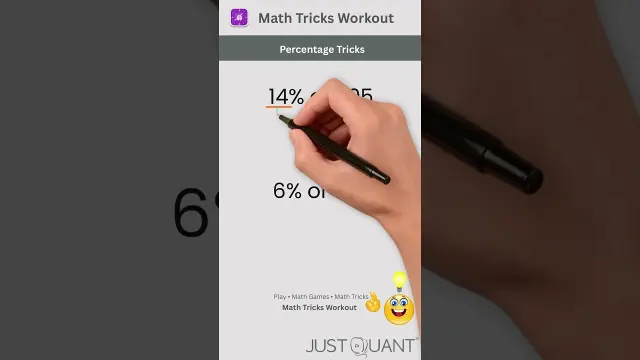 Fast Mental Math Percentage Calculation Trick Using Zero in the Middle
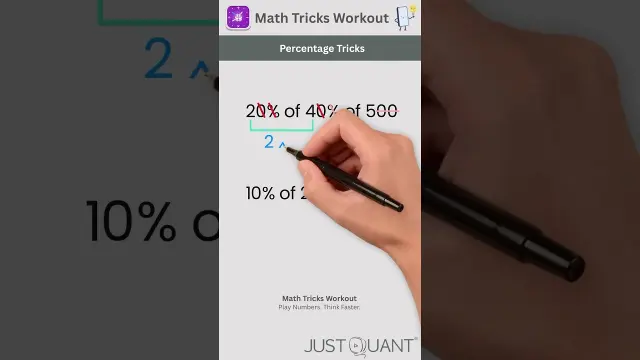 Chained Percentage Calculation Shortcut Using Zero Cancellation
Get new #Percentage Tricks ideas by email
Every Thursday: the week's best ideas, with the newest from #Percentage Tricks.
Related tags
Percentage Tricks for Faster Mental Math
What percentage tricks are
Percentage tricks are quick mental shortcuts for working out parts of a whole, comparing numbers, or finding increases and decreases. A percentage means “per hundred,” so it is simply another way of expressing a fraction or ratio. Once you understand that idea, many percentage questions become easier to handle without paper or a calculator.
These shortcuts are useful in everyday situations such as shopping, budgeting, cooking, splitting bills, checking tips, or estimating changes. They do not replace full calculation when precision matters, but they are very handy when you want a fast, reasonable answer.
The main ideas behind them
Read more
The easiest percentage tricks usually come from breaking a number into smaller, familiar parts.
- 10% is found by moving the decimal point one place to the left.
- 1% is found by dividing by 100.
- 5% is half of 10%.
- 20% is double 10%.
- 50% is half of the number.
For example, if you want 15% of a number, you can find 10% and 5%, then add them. If you want 12%, you can find 10%, then add 1% twice. This kind of step-by-step thinking is often faster and easier than trying to calculate everything at once.
Another useful idea is converting percentages into fractions you already know. For instance, 25% is one quarter, and 75% is three quarters. When the percentage matches a simple fraction, mental calculation becomes much more natural.
Zero-canceling and chained calculations
One common trick is zero-canceling. This works when numbers in the calculation share zeros that can be simplified before you multiply or divide. It is especially helpful in percentage problems involving round numbers.
For example, if you are finding a percentage of a number and both contain zeros, you can often simplify the arithmetic by stripping away matching zeros first. This makes the numbers smaller and easier to work with in your head.
Chained percentage calculations also become easier when you handle them in stages. If you need to apply several percentages one after another, it helps to think in terms of repeated multiplication by simple factors. For instance, a decrease followed by an increase is not the same as adding the percentages together directly. Working step by step keeps the result accurate.
Tips for beginners
If you are new to percentage tricks, start with the most common ones:
- Learn 10%, 5%, 1%, 20%, and 50% first.
- Break awkward percentages into easier parts.
- Use estimation to check whether your answer seems sensible.
- Remember that “of” usually means multiply.
- Be careful with increases and decreases, because they change the base amount each time.
It also helps to practise with real-life numbers. Try estimating discounts, taxes, and price changes in your head before checking with exact calculation. With a little repetition, percentage work becomes much quicker and more intuitive.
A simple habit that helps
The best percentage trick is not a single formula, but a calm way of thinking. Start with the base amount, identify a simple fraction or easy benchmark, and build up from there. If you can spot patterns like halves, quarters, tenths, and zeros, percentage problems become far less intimidating.
Videos come from YouTube and posts from Instagram; titles and summaries are our own. All rights belong to their creators.