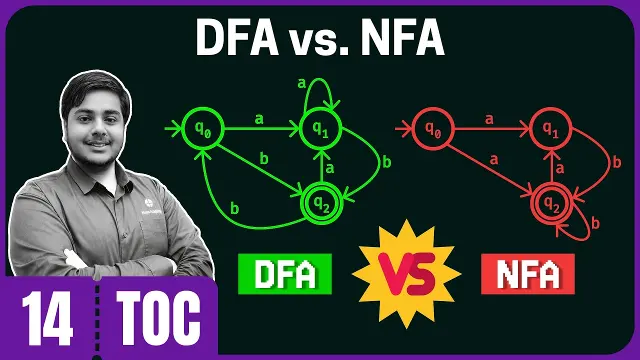
 Comparing Deterministic and Non-Deterministic Automata
#Finite Automata
16 ideas
Comparing Deterministic and Non-Deterministic Automata
 Finite Automata: The Smallest Possible Computers
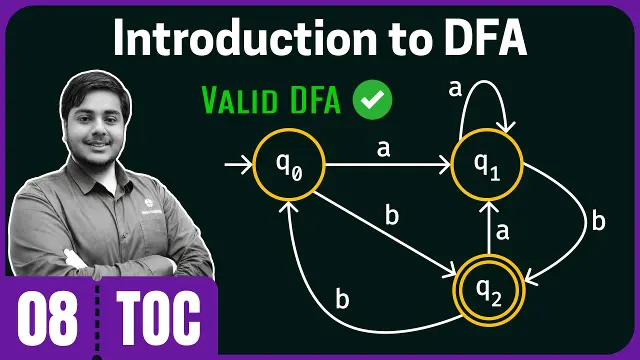 Introduction to Deterministic Finite Automata
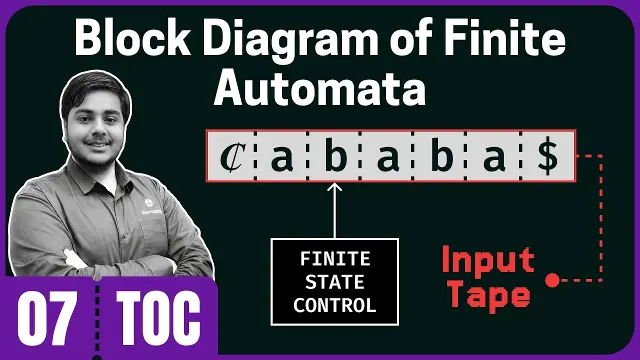 Understanding the Block Diagram of Finite Automata
 Comprehensive Guide to Finite Automata in Computer Science
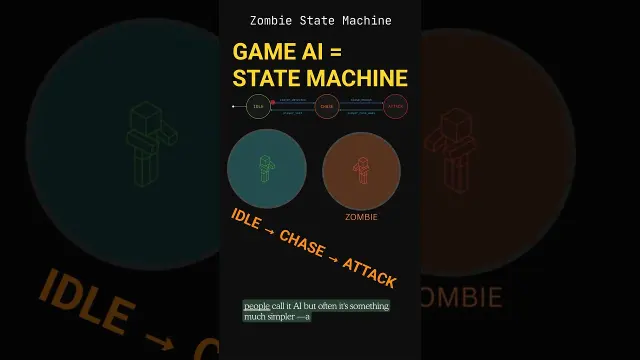 Finite State Machines Explained Using Game AI
 Deterministic Finite Automata for Pattern Recognition
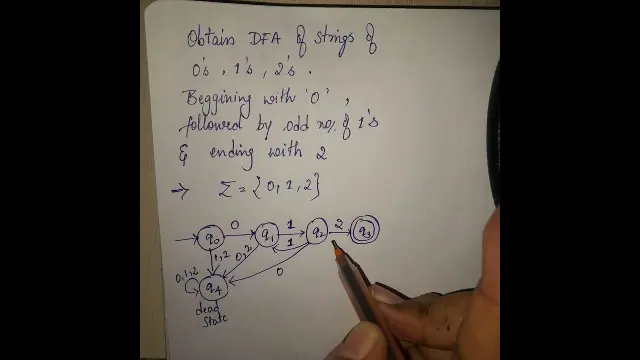 Designing a DFA for Specific String Conditions
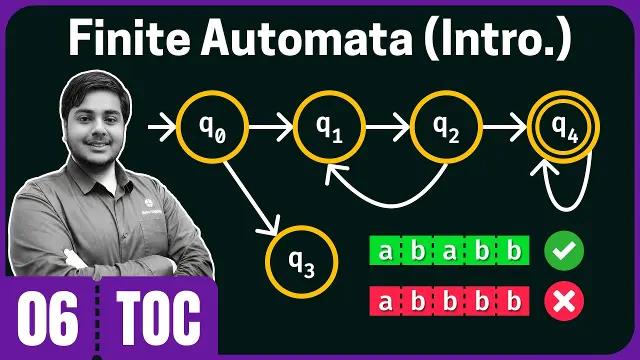 Introduction to Finite Automata and String Processing
 Finite Automata Explained in Quick Revision Shorts
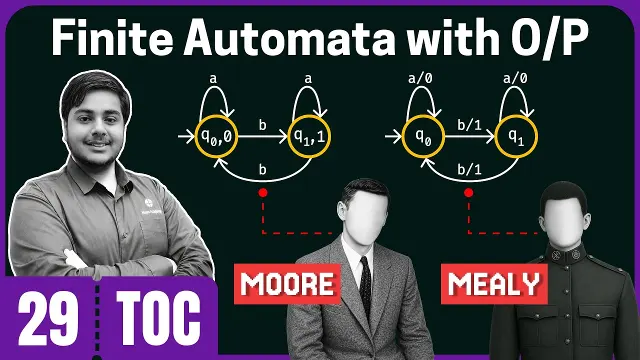 Introduction to Finite Automata with Output
 Finite Automata Concepts for Computer Science Exams
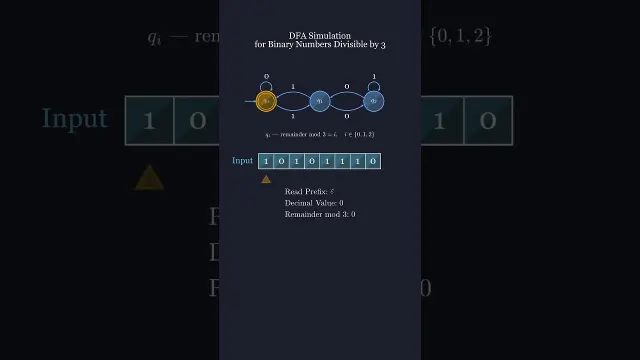 Simulating a DFA for Binary Numbers Divisible by Three
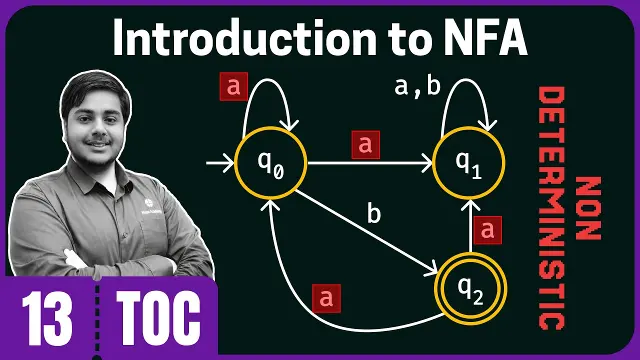 Introduction to Non-Deterministic Finite Automata
 Finite Automata String Matching Algorithm Explained
 Deterministic Finite Automata Made Practical for Coders
Get new #Finite Automata ideas by email
Every Thursday: the week's best ideas, with the newest from #Finite Automata.
Related tags
Finite Automata Explained
Finite automata are simple mathematical models used to represent systems that move through a limited number of states. They are one of the basic ideas in theoretical computer science and formal language theory. If you want to understand how computers recognize patterns, process strings, or describe simple rules, finite automata are a very useful place to start.
What a finite automaton is
A finite automaton is a machine that reads input one symbol at a time and changes state according to fixed rules. It always has a finite number of possible states, which is where the name comes from. At any point, the machine is in exactly one state, or in the case of a non-deterministic version, it may be understood as considering several possibilities at once.
Finite automata are often used to decide whether a string belongs to a particular language. In this context, a language is simply a set of strings built from an alphabet, such as letters or symbols.
Read more
Where the idea comes from
Finite automata grew out of logic, mathematics, and the study of computation. They are closely connected to regular languages, which are the simplest class of formal languages. Because the model is so precise, it is useful for proving what kinds of patterns a machine can or cannot recognize.
These ideas also appear in practical computing. Whenever a program checks whether text matches a certain pattern, or whenever a system reacts differently depending on a small number of conditions, the same basic thinking is often involved.
Main kinds of finite automata
There are two main types:
- Deterministic finite automata, or DFA: for each state and input symbol, there is exactly one next state.
- Non-deterministic finite automata, or NFA: for a given state and symbol, there may be several possible next states, or sometimes no next state at all.
Both types recognize exactly the same class of languages, even though they may be described differently. A DFA is usually easier to run step by step, while an NFA is often easier to design on paper.
How they work
A finite automaton usually has:
- a finite set of states
- an input alphabet
- a starting state
- one or more accepting states
- transition rules that describe how to move between states
The machine starts in the initial state and reads the input symbol by symbol. After the last symbol is read, if it ends in an accepting state, the input is accepted. Otherwise, it is rejected.
What beginners should know
If you are new to finite automata, focus first on tracing simple examples by hand. Draw the states as circles and the transitions as arrows. Then test short strings to see how the machine moves. This makes the idea much easier to understand than memorizing definitions alone.
A few useful habits:
- Start with very small alphabets and short strings.
- Pay attention to the meaning of each state.
- Check whether a state is accepting only at the end of the input.
- Remember that finite automata have no memory beyond their current state.
Why finite automata matter
Finite automata are a foundation for more advanced topics such as regular expressions, parsers, and compiler design. They also help you think clearly about pattern recognition and state-based systems. Even though they are simple, they capture an important limit: some problems need more memory than a finite automaton can provide. That makes them both practical and mathematically important.
Videos come from YouTube and posts from Instagram; titles and summaries are our own. All rights belong to their creators.