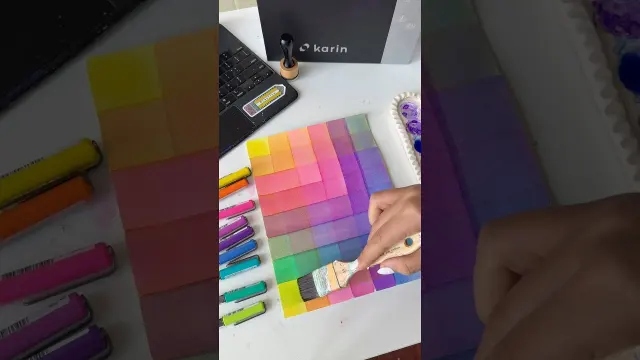
 A quick watercolor mandala for a creative reset
#Mandala
1 ideas
A quick watercolor mandala for a creative reset
Get new #Mandala ideas by email
Every Thursday: the week's best ideas, with the newest from #Mandala.
Related tags
Mandala Guide: Circles, Meaning and How to Draw Your Own
A mandala is a design built around a central point, usually circular, in which shapes and patterns repeat outward in a balanced, symmetrical way. The word comes from Sanskrit and is generally understood as "circle," though the idea behind it is wider than the round shape alone: a mandala is a picture of order, with a middle, a surrounding, and a relationship between the two. You will find them drawn on paper, painted on walls and cloth, built in stone, formed in sand and even arranged with flower petals or pebbles.
Where the tradition comes from
Circular, centred designs appear in many cultures, but the mandala as a named form belongs above all to the Hindu and Buddhist traditions of South Asia. In those settings it is not decoration first but a diagram: a map of a sacred space, used for meditation, ritual and teaching. Tibetan Buddhism is especially known for elaborate sand mandalas, patiently laid out grain by grain and then deliberately swept away, a practice that carries its own meaning about impermanence. Related forms exist in other traditions too, and the basic geometry — a centre, radiating axes, concentric rings — turns up almost anywhere people have wanted to express balance.
The main kinds
Read more
Broadly, you can sort mandalas into a few families. There are traditional ritual diagrams, precise and rule-bound, with meaning attached to every element. There are architectural and decorative versions, as in the circular patterns found in temple floors and ceilings. There is the sand mandala, temporary by design. And there is the modern hand-drawn or coloured mandala, which borrows the form without the ritual framework and is made for calm, focus and the pleasure of pattern. None of these is more "real" than the others; they simply come from different intentions.
Starting your own
The encouraging thing about mandalas is that the structure does most of the work. Begin with a dot in the middle of your paper, then let a circle grow around it. Work outward in rings, adding one repeated motif per ring — petals, arcs, dots, small triangles — and let each ring answer the one before it. A compass and a ruler help, but freehand wobble is part of the charm.
Decide early whether you want symmetry by rotation (the same shape turned around the centre) or by reflection (mirrored across lines through the centre), then keep to it. Build from the inside out, keep your pen pressure light until you are sure of a shape, and stop adding rings while the design still feels open rather than crowded. If drawing feels daunting, start with a printed outline and colour it in; the concentration is the same.
A note on the frame of mind
People often describe mandala-making as settling. That is worth keeping modest: it is a pleasant, absorbing craft, not a treatment for anything. Take it as a quiet half hour with a pen, and let the circle hold your attention.
#Mandala: frequently asked questions
What is a mandala, exactly?
It is a design built around a central point, usually circular, where shapes repeat outward in a balanced, symmetrical way. The word comes from Sanskrit and is generally understood as "circle," but the form is really a picture of order — a middle, a surrounding, and the relationship between them. You will find mandalas drawn on paper, painted on cloth and walls, built in stone, poured in sand, or arranged from petals and pebbles.
How do I begin drawing a mandala with no experience?
Start with a dot in the centre of your paper and let a circle grow around it, then work outward in rings. Add a repeated motif to each ring — petals, arcs, dots, small triangles — and let every ring answer the one before it. A compass and ruler help, but a freehand wobble is part of the charm, so don't wait until you feel skilled to begin.
What supplies do I need to make one?
Very little: paper, a pencil, and something to draw circles with is enough to start. A ruler helps keep your radiating lines even, and fineliners or coloured pencils are nice once you are happy with the layout. If drawing feels daunting, a printed outline and a set of colours give you exactly the same concentrating pleasure.
Which kind of mandala should I choose?
It depends on what you want from it. Traditional ritual diagrams are precise and rule-bound, with meaning attached to every element, while sand mandalas are made to be swept away and architectural versions live in stone and paint. The modern hand-drawn or coloured mandala borrows only the form, and is made for calm, focus and the pleasure of pattern — none of these is more "real" than the others.
What are the common mistakes to avoid?
The usual one is crowding — adding rings long past the point where the design still feels open and airy. Another is pressing hard too early, which makes a wrong line hard to correct; keep your pen pressure light until you are sure of a shape. Finally, decide up front whether your symmetry works by rotation or by reflection, because mixing the two halfway through is what makes a design look muddled.
Are there easy ideas for a particular occasion or mood?
A quick watercolor mandala makes a refreshing creative reset when you want something loose and unhurried, and a pencilled outline coloured in suits a quiet evening. Because the structure does most of the work, the same approach scales from a small card to a large painted panel. Treat it as a pleasant, absorbing craft rather than a cure for anything, and the calm tends to follow on its own.
Videos come from YouTube and posts from Instagram; titles and summaries are our own. All rights belong to their creators.