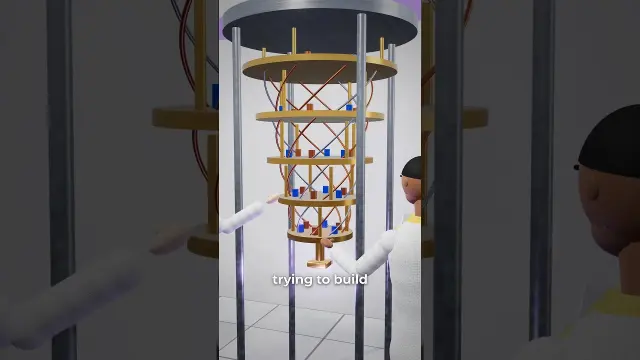
 Animated Explainer: How Quantum Computers Could Crack Passwords
#Cryptography
3 ideas
Animated Explainer: How Quantum Computers Could Crack Passwords
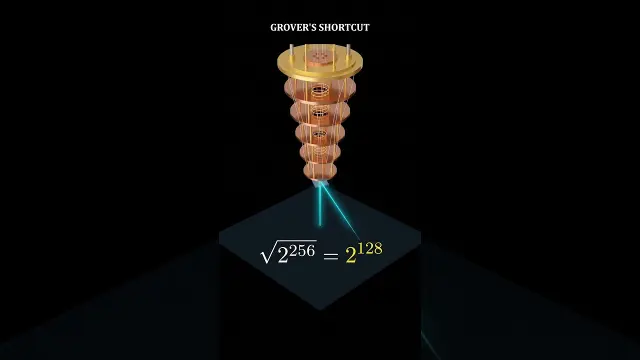 Can Quantum Computers Break 256-Bit AES? Grover's Algorithm
 Shor's Algorithm Explained by a Computer Scientist and Physicist
Get new #Cryptography ideas by email
Every Thursday: the week's best ideas, with the newest from #Cryptography.
Related tags
A Beginner's Guide to Cryptography
Cryptography is the craft of keeping information readable to the people it is meant for and unreadable to everyone else. The word comes from the Greek for "hidden writing", and the idea is old: long before computers, people scrambled messages with substitution alphabets, transposition grids and shared codebooks, and their opponents spent just as long trying to unscramble them. What changed over the centuries is not the ambition but the mathematics behind it.
Symmetric encryption
The oldest approach uses one secret. You and the person you are writing to agree on a key in advance; the same key locks the message and unlocks it. This is fast and elegant, and it is still what protects most data once a connection has been established. Its weak point is obvious: how do you get the key to someone without an eavesdropper taking it? Every additional person who needs to read your messages needs the key too, which makes sharing harder as a group grows.
Asymmetric encryption
Read more
Public-key cryptography solves the delivery problem by giving each person a pair of related keys. One is public and can be handed out freely; the other stays private. Anything encrypted with the public key can only be opened with the private one, and a signature made with the private key can be verified by anyone holding the public one. The security rests on mathematical problems that are easy to perform in one direction and punishingly hard to reverse.
Hashing and authenticity
Not everything in cryptography is about hiding. A hash function takes any input and produces a fixed-length fingerprint. The same input always gives the same fingerprint, a tiny change gives a completely different one, and you cannot work backwards from the fingerprint to the input. Hashes are how systems check that a file arrived intact and how passwords are stored without keeping the passwords themselves.
Three things worth telling apart
Encoding changes the form of data so it can travel safely — it hides nothing. Hashing is one-way and used for verification. Encryption is reversible, but only with the right key. Mixing these up is one of the most common beginner mistakes.
Practical habits
Do not invent your own cipher or write your own implementation of a standard one; use well-reviewed libraries and let them handle the details. Never reuse a key or a password across services, and prefer long passphrases you can remember over short strings of symbols. Assume that anything sent over a network can be recorded, and treat the small padlock in a browser as a sign of an encrypted connection, not as proof that the site is honest. Finally, remember that cryptography protects data, not people: a stolen key defeats the strongest cipher ever designed.
#Cryptography: frequently asked questions
What is cryptography in simple terms?
Cryptography is the practice of protecting information so only the intended people can read it. It uses methods such as encryption, hashing, and signatures to keep data private, verify it, or prove it came from the right source.
What is the difference between encryption, hashing, and encoding?
Encryption hides data and can be reversed with the correct key. Hashing turns data into a one-way fingerprint for checking integrity, while encoding only changes the format so data can travel or be stored properly.
Should I use symmetric or public-key cryptography?
Symmetric encryption is usually faster and works well once both sides already share a secret key. Public-key cryptography is better when you need to exchange keys safely or prove identity, since one key can be shared openly while the other stays private.
What do I need to start using cryptography safely?
Use trusted, well-reviewed libraries instead of inventing your own cipher or writing your own implementation. Also keep keys and passwords unique, choose strong passphrases, and assume that anything sent over a network could be recorded.
What are common mistakes beginners make with cryptography?
A very common mistake is confusing encryption with hashing or encoding, which leads to using the wrong tool for the job. Another is reusing passwords or keys across services, or assuming that a secure connection automatically means a site is trustworthy.
How can cryptography help with modern threats like quantum computers?
Quantum computers raise concerns for some widely used public-key methods because they may eventually make certain hard math problems easier to solve. That is why cryptography keeps evolving, with researchers working on new approaches that are designed to resist quantum attacks.
Videos come from YouTube and posts from Instagram; titles and summaries are our own. All rights belong to their creators.