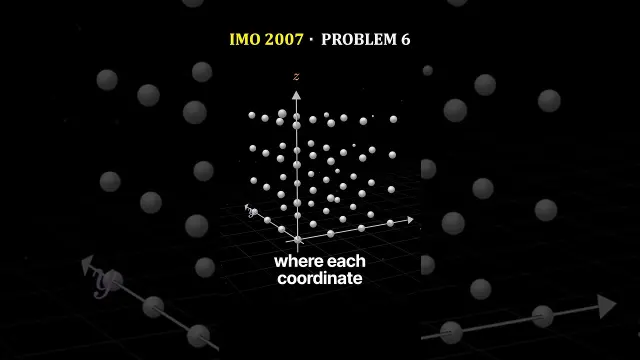
 IMO 2007 Problem 6: Covering a Grid with the Fewest Planes
#Olympiad Math
3 ideas
IMO 2007 Problem 6: Covering a Grid with the Fewest Planes
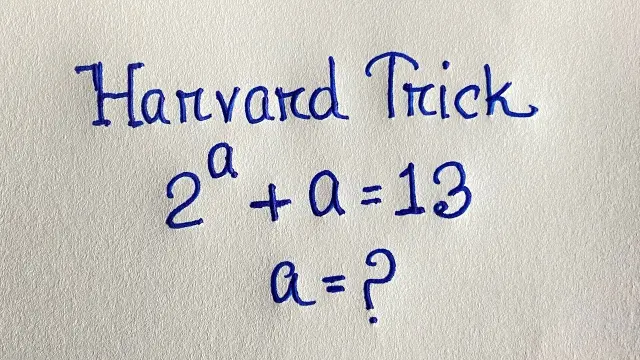 Solving a Challenging Harvard Exponential Math Olympiad Question
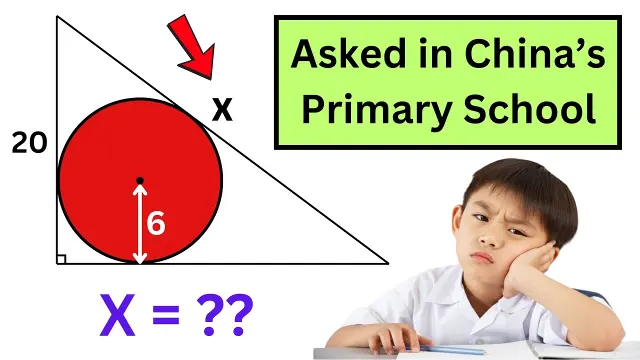 Geometry Math Olympiad Entrance Exam Problem Solved
Get new #Olympiad Math ideas by email
Every Thursday: the week's best ideas, with the newest from #Olympiad Math.
Related tags
Olympiad Math: A Beginner's Guide to Problem Solving
Olympiad mathematics is the branch of competition mathematics built around proof rather than calculation. Instead of applying a known formula to a familiar exercise, you meet a problem that looks unfamiliar and have to find the idea that unlocks it, then explain why the answer must be true in every case. The subject grew out of the older tradition of mathematical contests, and the best known of them, the International Mathematical Olympiad, has been running since 1959 — enough time for a whole culture of training, problem archives and study groups to grow around it.
A defining feature is that the toolbox is small. Olympiad problems rarely need anything beyond school algebra and geometry. What they demand is originality: a clever substitution, a well-chosen case, a way of pairing things, a symmetry you notice before anyone else.
The four main areas
- Algebra: functional equations, polynomials, systems, and the art of manipulating expressions without losing track of what is allowed.
- Number theory: divisibility, primes, congruences, diophantine equations. Proofs here are often short and unforgiving.
- Geometry: synthetic proofs about circles, tangents, triangles and concyclicity, where a good diagram is half the work.
- Combinatorics: counting, graphs, colourings and arrangements, plus proof techniques such as the pigeonhole principle, the extremal principle and invariants.
Read more
What beginners should know
The single most useful habit is not to give up too early and not to give up too late. Give a problem real time — an hour is not excessive — before reading a solution. When you do read one, close the page and rewrite the whole argument from memory. The gap between "I understood it" and "I can produce it" is where learning happens.
Try small cases by hand. Replace the large number in the problem with two, three, four, and see what pattern appears and what breaks. Many olympiad solutions are just a pattern you had the patience to notice, followed by an honest proof by induction.
Learn what a complete proof looks like. In olympiad work, an argument that feels obvious still needs saying: every case covered, every assumption justified, every "clearly" earning its place. A construction that satisfies the conditions is as valuable as a general theorem, and a single counterexample can close a question forever.
Practical training
Work from a broad archive rather than a single book, and keep a notebook of problems you failed twice — those are worth more than the ones you solved. Practise writing solutions in full sentences on paper, because that is what a competition asks of you. Study in company when you can: explaining a proof out loud exposes the step you were quietly skipping, and hearing a friend's different approach doubles your toolkit.
Finally, do not treat olympiad mathematics as a test of innate talent. It rewards curiosity and stubbornness, and nearly everyone who improves does so by solving an unfashionable number of problems slowly.
#Olympiad Math: frequently asked questions
How do I start preparing for olympiad mathematics as a beginner?
Start with problems that seem a little above your current level, then give yourself real time to struggle before looking at a solution. After you read an explanation, close it and try to rebuild the proof in your own words, because that is what turns understanding into real skill.
What kind of math do I need for olympiad problems?
Most olympiad problems use school-level algebra and geometry, but they ask you to think in a much more original way. It helps to be comfortable with divisibility, congruences, basic proof methods, diagrams, and careful symbolic manipulation.
Which olympiad topic should I choose first: algebra, number theory, geometry, or combinatorics?
Choose the area that feels most natural to you first, because early progress is easier when the style of thinking matches your strengths. If you like equations and patterns, try algebra; if you enjoy clean logic and structure, number theory or combinatorics may be a better starting point; if you like pictures and construction, geometry is a strong choice.
What is the best way to improve at solving olympiad math problems?
Practice from a wide range of sources instead of relying on one set of exercises, and keep a notebook of problems you could not solve right away. Reworking failed problems, writing full solutions, and discussing ideas with others are some of the fastest ways to improve.
What are common mistakes people make in olympiad math?
A common mistake is stopping too early or, just as often, spending too long without changing strategy. Another frequent error is writing a solution that feels convincing but does not actually prove every step, every case, or every assumption.
Videos come from YouTube and posts from Instagram; titles and summaries are our own. All rights belong to their creators.