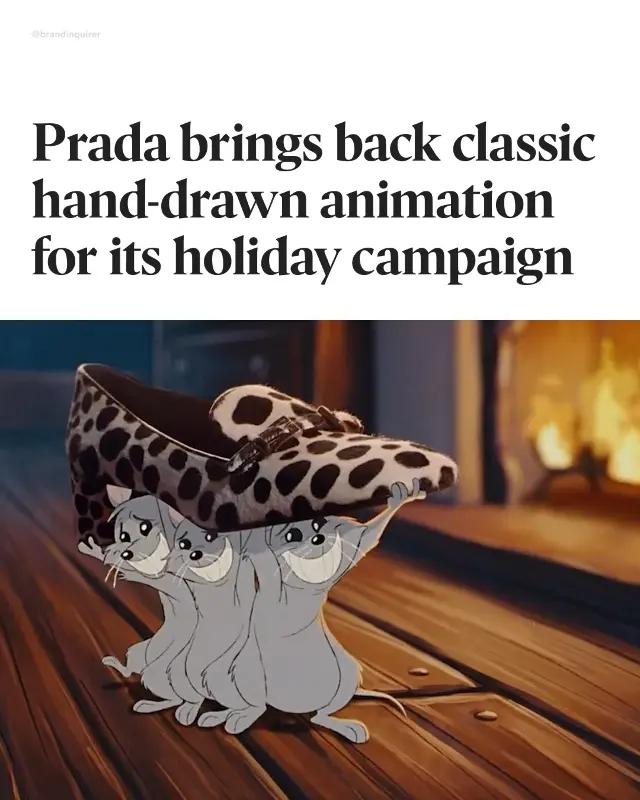
 Prada Brings Hand-Drawn Animation Back for Holiday Campaign
#Animation
40 ideas
Prada Brings Hand-Drawn Animation Back for Holiday Campaign
Get new #Animation ideas by email
Every Thursday: the week's best ideas, with the newest from #Animation.
Related tags
Animation: An Evergreen Guide
Animation is the art of bringing drawings, models, objects, or digital images to life through movement. It works by showing a sequence of images so quickly that the eye reads them as motion. This simple idea has a long history and appears in many forms, from hand-drawn cartoons to stop-motion films and computer animation.
At its heart, animation is a visual storytelling tool. It can entertain, explain, teach, and express ideas that would be difficult to show in live action. Because it is so flexible, animation is used in films, television, advertisements, educational videos, games, and online content. It can feel playful and simple, or detailed and cinematic.
Main kinds of animation
There are several well-known approaches to animation:
Read more
- Traditional animation uses hand-drawn images, often created frame by frame.
- Stop-motion animation uses physical objects, puppets, paper cutouts, or clay that are moved a little between each frame.
- Computer animation is made digitally, using software to create and move characters and scenes.
- 2D animation works with flat shapes and drawings.
- 3D animation creates the impression of depth and volume, like moving objects in a digital space.
Each style has its own look and rhythm. Some feel handmade and textured, while others are smooth and polished. The best choice depends on the story you want to tell and the feeling you want to create.
How animation works
Animation relies on timing, movement, and continuity. A character does not simply jump from one position to another. Instead, the movement is broken into many small changes. These changes create the illusion of life. Good animation often pays close attention to weight, pause, anticipation, and expression, because these details make movement feel natural and believable.
For beginners, it helps to start small. Simple bouncing balls, moving shapes, or short character actions are useful exercises. These basics teach timing and spacing before moving on to more complex scenes.
What beginners should know
If you are learning animation, focus first on clear movement rather than complicated effects. A strong idea and readable motion matter more than advanced tools. It also helps to sketch, plan, or storyboard before animating, so you know what happens in each scene.
A few practical tips can make the process easier:
- Keep your first projects short.
- Study real movement in people, animals, and objects.
- Think about how weight affects motion.
- Use pauses and changes in speed to avoid stiff movement.
- Pay attention to facial expression and body language.
Why animation matters
Animation is popular because it can simplify complex ideas and create worlds that would be impossible to film directly. It can be funny, emotional, educational, or imaginative. Whether made by hand or with software, animation remains one of the most expressive visual arts, and it rewards patience, observation, and creativity.
Videos come from YouTube and posts from Instagram; titles and summaries are our own. All rights belong to their creators.